
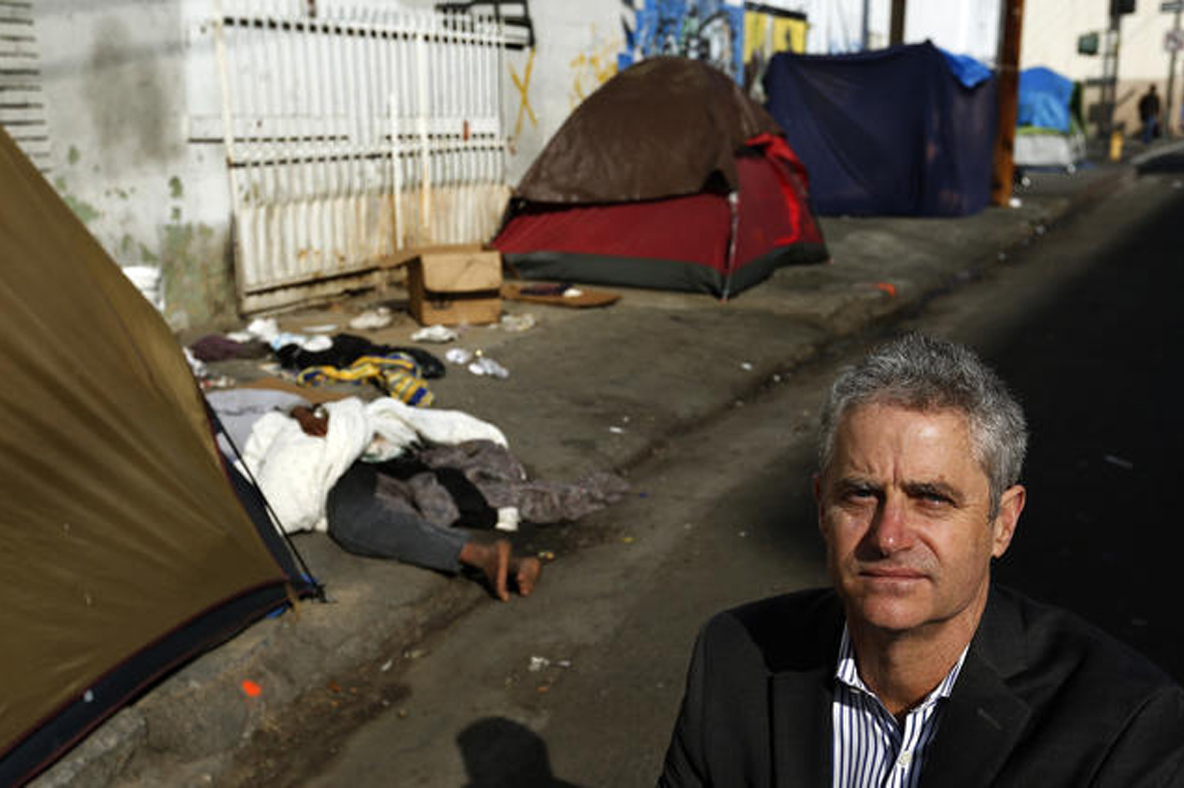
New homeless housing to be built using the $1.2-billion bond Los Angeles city voters approved in November may be three to five years in the future.
In the meantime, a program created by Mitchell H. Katz, director of the Los Angeles County Department of Health Services, is striving to get thousands of the most debilitated homeless people off the streets sooner.
Using county and private foundation funds, Housing for Health is identifying homeless people who make disproportionate use of county health services and getting them into market-rate housing with intensive case management. It expects to house 10,000 people by the time Proposition HHH begins to turn out new units.
Housing for Health Director Marc Trotz, who worked with Katz to set up a similar program in San Francisco, was interviewed in his office at the Star Apartments on skid row.
Why is the Health Services Department involved in housing?
His [Katz’s] take on it was, “What I really need on my prescription pad is a prescription for housing. I have the tools to control their high blood pressure, to control diabetes, but it doesn’t add up to a hill of beans for a homeless person if they’re living on the street.”
Isn’t it better to construct dedicated housing than to rely on a tight housing market?
A new housing project can take up to five years for completion. Five years of work and you create 100 units of housing. That’s not going to cut it. They open, you identify 100 people and that’s great. And the buildings are great. But those opportunities are spread out over time. We need to be housing homeless people every day.
I personally think that for good or for bad we have a capitalist housing market in this country, and we won’t be able to get on top of the homeless situation solely through housing development, which is so great, but there is just not enough capacity there, realistically.
How does Housing for Health get vulnerable people into homes?
We started the Flexible Housing Subsidy Pool — $4 million from Hilton Foundation, $14 million from the county — to create a local rent subsidy.
We hired [nonprofit] Brilliant Corners to be our housing intermediary — they’re like a housing authority without the restrictions that come with federal subsidies — to operate this flexible pool and do things in a more nimble and quick way. That’s the real estate side.
On the services side, we created this innovative master agreement, which essentially allows us to vendorize the whole “who’s who” of the housing service community. At this point, we have 35 or 40 organizations all able to do this work. When we have a homeless person referred to us through the hospital, through one of our clinics or through one of our many partners, they get assigned to an intensive case management agency like OPCC or Housing Works.
We fund … groups to do this intensive case management at a ratio of one case manager per 20 homeless people.
You use the term “intensive” case management. What does that mean?
It is everything from driving them to the DMV if they need to get their California ID to making sure they have a primary care provider and making sure they see that primary care provider, [and] if they are mentally ill and need to be enrolled in a local outpatient clinic or have additional full-service partnership hookup or whatever it is, that they have that. That’s what we mean by the “anything-it-takes approach.”
Who are your target clients?
We’re directly targeting people who are the highest utilizers of our healthcare systems. So the folks that in some cases, if you’re just looking at the economic side, who utilize $50,000 to $150,000 per year in avoidable costs in emergency medical services. We’re saying we should put them in supportive housing at $20,000 a year.
In some ways we would say people who have been in one of our health locations two or more times in the last year. But it is really a more in-depth look at their medical records. We have clinicians upstairs, a little troop of nurses reviewing the referrals and constantly clinically triaging people into housing.
How many people have you housed so far?
We started our first year at 300. Next year it grew to 600. We’re in the year right now where it’s growing to 1,200.
The last time I looked at our numbers, we had housed over 2,000. And we have about 2,000 people in progress right now. That means people that we have identified that are connected to intensive case management services and that we’re trying to house. We’ll be at 4,000 in no time.
How much does it cost?
Those services cost about $450 per month. You take a rent subsidy that’s now grown to $950 per month with what’s happening in the housing market. Add in administrative costs. You put all that together, you get about $1,500 per month.
The $18 million that seeded the Flexible Housing Fund won’t last much longer. And if you house 10,000, the rent and services combined will cost $180 million every year. Where will it come from?
So far, Dr. Katz has been very creative in using the health budget. He’s created a lot of efficiencies by directing funds to interventions with demonstrated outcomes.
Through prevention and activities like supportive housing, he’s been able to redirect money within the existing health system. In doing this he has not asked for more money from the county.
However, to reach the expansion we all need to get to get to, there will need to be a new revenue source. Because rents and support are ongoing costs.
Why is a local subsidy needed?
Traditionally communities have relied on Section 8, which is a rent subsidy. Actually, there’s a variety of names for federal rent subsidies: VASH [Veterans Affairs Supportive Housing], Continuum of Care, Shelter Plus Care. Those all are federal rent subsides administered through the local housing authorities that are predicated on the tenant paying 30% of their income toward rent and the federal government paying the rest.
Those programs are extremely limited. There is no way we can end homelessness in L.A. using just federal rent subsidies. There’s been a lot of bellyaching for a long time over the reduction of [the Department of Housing and Urban Development’s] budget for Section 8 starting with the Reagan era. All cities have extreme shortages. We can bellyache about the lack of federal subsidies or create our own.
You say you are “somewhat” optimistic the problem can be solved. What do you mean?
I think we should be able to house 20,000 people. What if we had an earthquake … and 20,000 people’s homes were demolished? We would know how to temporarily house those people. We’d bring in the mobile showers and whatever else is needed.
That’s the thing that vexes me that I hope changes. You see amazing things happen in L.A. — Grand Park turning into this 10,000 person extravaganza on Friday night and it’s all cleaned up by Monday morning.
Why can’t we really address skid row as the health emergency it is? Let’s bring that same energy and can-do spirit to skid row and other areas of the county with large numbers of homeless people.