
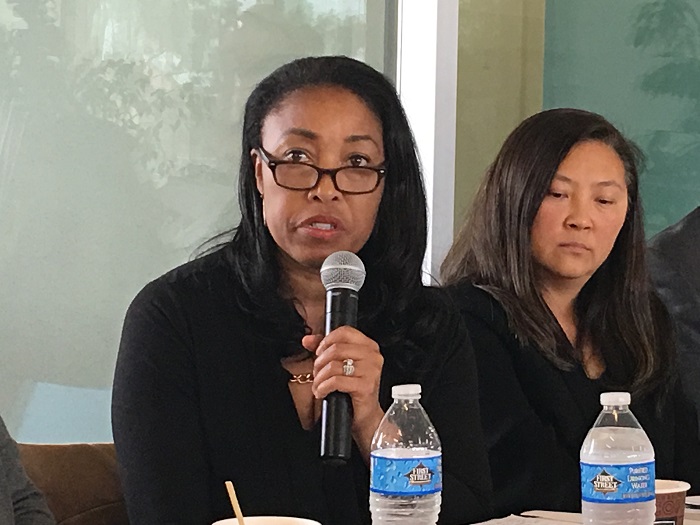
Ethnically diverse advocates detailed their efforts to eradicate homelessness during New America Media’s forum at Skid Row Housing Trust’s Apartments on Feb. 3.
Panelists hailed from African-American, Chinese, Latino and Korean backgrounds. The briefing focused on how L.A. County is working to raise awareness among our audiences about the diversity of its homeless population and how all ethnic groups have a stake in working to end it.
From helping homeless men, women, and youth get back on their feet, to helping to curb socio-economic ills that contribute to their conditions, there has been progress. Advocates stressed keys to ending homelessness include permanent housing, more funding, public support and involvement, and cultural competent care.
“Who we hire is important, and how they’re trained is also something we must pay close attention to. If we have a population that represents 40 percent of the homeless, we should hire folks that are reflective of their experience, that are sensitive to what they’ve been through,” said Va Lecia Adams Kellum, president and CEO of St. Joseph Center.
“I’m not saying that everybody who does this work has to be African American or Latino, or Asian, but what I am saying is we certainly should be among the people that you’re hiring, and more importantly, there should be a cultural sensitivity and an understanding of what it takes to serve a unique and special population,” Ms. Kellum stated.
Blacks disproportionately bear the brunt of homelessness on national, state and local levels, Ms. Kellum detailed:
• Blacks are about 12.6 percent of the country’s population, but make up 40 percent of its homeless population.
• Blacks made up 39 percent of the county’s homeless population, in 2016, but nine percent of its general population.
• Twenty-nine percent of Blacks live below poverty in L.A. County, but are only 12 percent of those documented as impoverished.
Ms. Kellum cited a loss of affordable housing, mass incarceration, a decrease in middle class jobs, and access to public mental health as other contributing factors to Black homelessness.
How did Blacks get to such an embarrassing place with the levels of homelessness, Ms. Kellum asked. Clearly overt and systemic discrimination, she answered.
Those have led to decreased access to adequate housing, jobs, and financial instability, and a community feeling like there’s no place to turn when things fall apart, she observed. Part of the problem is not wanting to bring others down, and part is pride, she opined.
That was part of Reba Stevens’ dilemma
She was 19 and a college student who was housed as a caregiver for an elderly woman. “I was happy and content, until she died,” Ms. Stevens said.
The elder’s family member they didn’t know existed showed up and kicked the teen and her two-year-old daughter out on the streets, she said.
“I was full of pride, and I was afraid of what I was experiencing, so I abandoned my daughter to my mother,” she said. She found herself drinking to numb herself from her own thoughts. That led to all night bus rides.
She was filled with fear, and then introduced to other drugs and petty theft. She was faced with almost five years in prison due to stiffer laws. She became a victim to the streets and a battered woman just trying to survive.

Phil Ansell, Director of the Los Angeles County Homeless Initiative discusses combating homelessness across the county Photo by Charlene Muhammad
Until supportive services saved her. “I never will forget the day that I was in my 12th program, a recovery facility … She walked in and sincerely asked, ‘How you doing, Ms. Stevens?’ ”
That led to the beginning of change in her life, she said. Loving, caring people tended to her. Now she staunchly advocates for Measure H and supportive services.
If passed by voters during the March 7 elections, Measure H would authorize a 0.25 percent county sales tax for 10 years in order to fund homeless services and prevention to the tune of about $350 million, according to proponents.
“It will meet the individual’s needs. We’re talking about essential services. So this is across the board. How is it that what you need may be what I need? It’s not always that way,” Ms. Stevens said.
Ms. Kellums also feels that there is hope. Over the last 10 years, she’s witnessed an amazing effort of change and the start of implementing best practices. She applauded L.A. City and County officials’ commitment to do differently, and in part, their seeking funding through Measure H.
According to the County of Los Angeles Homeless Initiative, the six areas which are key to combating homelessness are prevention, subsidized housing, increased income, case management and services, a coordinated system, and increased affordable housing/homeless housing.
Proceeds from the Measure H tax will be used to generate ongoing funding to prevent and combat homelessness within Los Angeles County, including funding mental health, substance abuse treatment, health care, education, job training, rental and housing subsidies, case management and services, emergency and affordable housing, transportation, outreach, prevention, and supportive services for homeless children, families, foster youth, veterans, battered women, seniors, disabled individuals, and other homeless adults.
Victims of domestic violence are eligible for services under the full range of the above strategies, in particular rapid rehousing, according to Phil Ansell, director of the Los Angeles County Homeless Initiative. “In most instances, women who are victims of domestic violence will have the ability over time to earn an income and pay their own rent, and therefore rapid rehousing in particular are well suited for victims of domestic violence,” he said.
According to the Department of Housing and Urban Development, the Homelessness Prevention and Rapid Re-Housing Program will provide financial assistance and services to prevent individuals and families from becoming homeless and help those who are experiencing homelessness to be quickly re-housed and stabilized.
Funds under then program target individuals and families who would be homeless but for this assistance, and will provide for a variety of assistance, including short-term or medium-term rental assistance and housing relocation and stabilization services (including such activities as mediation, credit counseling, security or utility deposits, utility payments, moving cost assistance, and case management).
HUD mandates at least 60 percent of funds must be spent within two years, and all funds must be spent within three years.
Celina Alvarez, executive director of Housing Works, spoke about homelessness in the Latino community.
Society has conditioned people to think about the undocumented, but she urged everyone to think about the problem through a different lens.
“There are many fellow brothers and sisters, Latinos, Latinas, who are homeless because of being displaced due to gentrification,” Ms. Alvarez stated. “… families are being uprooted and displaced into geographies that they’ve never ventured into,” she said.
That’s important to factor in when thinking of ways to provide effective, culturally competent services, she argued.
“Over last 35 years, our society has been faced with a persistent and unrelenting immoral dilemma. Thousands of people living on our streets and in our parks under and along our freeways with no home,” Ms. Alvarez stated.
She said it wasn’t just specific to the Latino community, but a lack of support networks affects everyone, she said.
“Every human being deserves the right to a home, but they also deserve the right to a community that understands the value they bring to the table,” Ms. Alvarez stated.