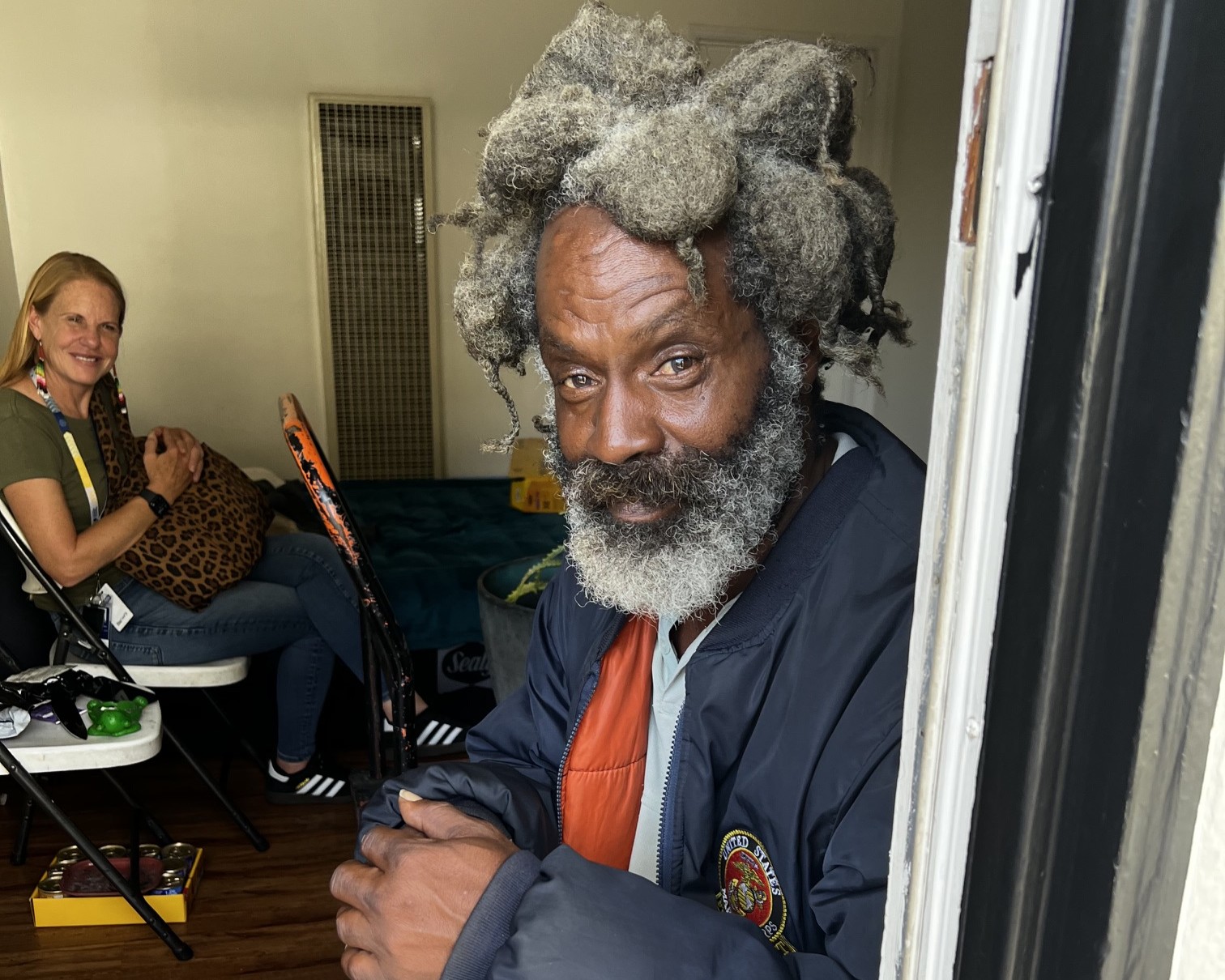
On a recent summer morning, the 50-block area that makes up Skid Row in east downtown Los Angeles bustles with activity. On one corner, a homeless man is hosing the dirt off a sidewalk. A few blocks away, the Blue Hollywood Street Sanctuary has set up tables under white tents, offering a place to rest as well as a variety of resources. “We give you what you need,” says Derrick Metoyer, a case manager with the nonprofit organization. He ticks off a few items — “Wound care, t-shirts, water… We’re here at three in the morning. We’re here at 12 o’clock in the afternoon.”
Weaving her way through the neighborhood is Sieglinde Von Deffner, the Skid Row care coordinator for the Los Angeles County Department of Homeless Services and Housing. She spends a few hours a day walking around, checking up on people, offering calm advice and pulling cigarettes and other supplies from her big tote bag for anyone who asks.
She knows their life stories, and they know she is a connection to much of what is valued in life—housing, medical care, concern, and comfort. With her long strawberry blond hair, she is an unmistakable presence on these streets.
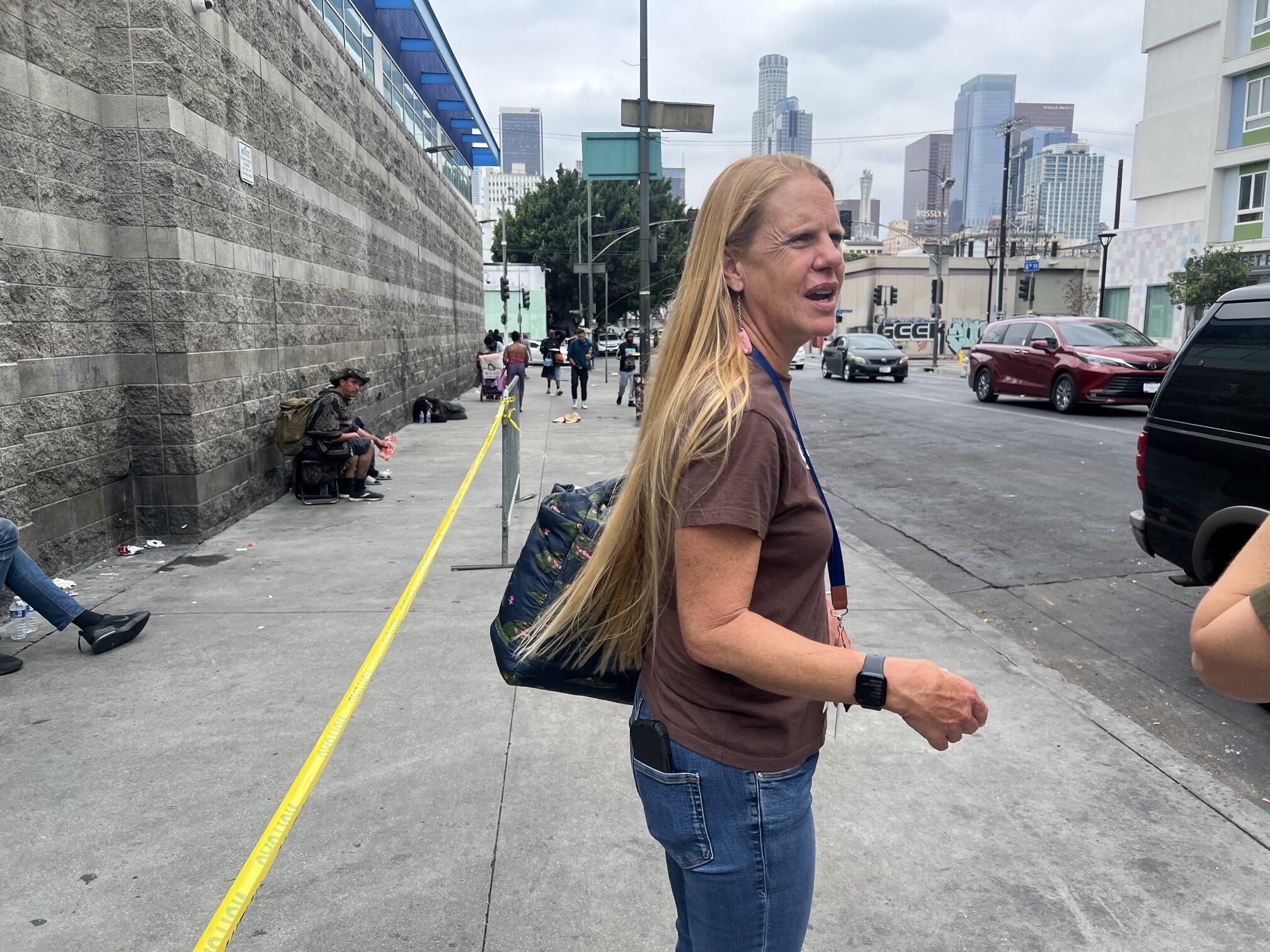
“I try to spend a couple of hours a day here,” she says, “just because I love the community. I want to talk to people and make sure they are getting linked to the resources they need. If they’re supposed to have a case manager come see them, is the case manager doing that?”
Groups of people sitting in rows of chairs on a sidewalk greet passers-by—as if this slice of sidewalk were an array of front porches in a neighborhood. “Hi, Sieglinde!” calls one woman in a wicker chair.
“Has anyone been by to check on you?” Sieglinde asks her. No, the woman replies. “I’m worried about your health,” Sieglinde tells her, saying she will find someone to check on her.
On another block, a young woman stops Sieglinde. “I’m ready for housing,” she says. “I want to get my kids back. I have four kids.”
“Go to the Care Campus and ask for a case worker,” Sieglinde instructs her. “If you have had mental health issues—”
“I haven’t,” interrupts the woman, “but I wouldn’t mind some therapy.”
A woman with vivid purple hair smiles and stops to talk to Sieglinde. “I love the purple,” says Sieglinde. The woman, who had been living outside, now lives in interim housing in a single-room occupancy building with supportive services for homeless and low-income individuals.
“She has her own room,” says Sieglinde. “She’s done well.”
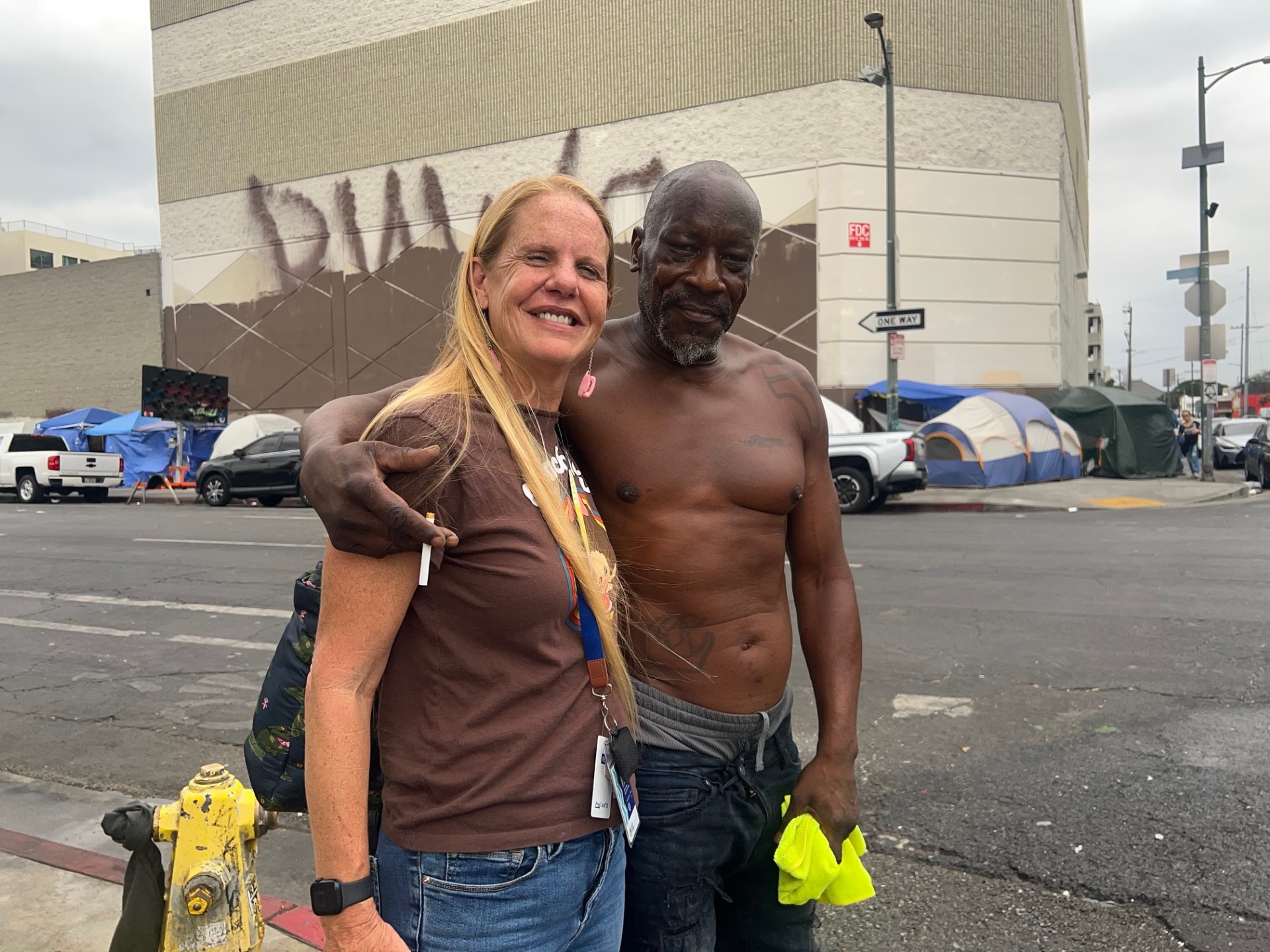
Corey, the tall, muscled man watering down the sidewalk, greets passers-by. When a woman walks by in pants but bare-chested, he shouts a plea for her to cover up. She looks at him expressionlessly and keeps walking. Zeke, the beloved pit bull watched over by a village of caretakers including Corey, a few other residents and the dog’s owner, rests in his kennel on the sidewalk taking in the scene. Corey complains about the so-called animal rescuers who show up in Skid Row wanting to take the dog and other people’s dogs:
“They say, ‘Can we take your dog and take care of him?’ I said, ‘Can we go with you?’ They say, ‘Oh, no,’” Corey recounts. “I say, ‘I’m not letting you take my dog.’”
“Another woman came by and said, ‘Can I buy your dog for $700?’ I said, ‘Can I buy your daughter for $700?’”
He seems to have taken charge of this little corner in a confident, no-nonsense manner. “Corey lives in one of these tents,” says Sieglinde. “We’ve been chipping away at getting him into housing.”
Skid Row is complicated. With a few thousand unhoused people—roughly half unsheltered– it has the densest population of homelessness in Los Angeles County even though that’s just a fraction of the 73,000 homeless people who populate the entire county, according to the 2026 Point-in-Time Count. But Skid Row also has the highest rates of substance use and mental health crises.
The year-old Skid Row Care Campus is something of an anchor and safe haven for this community to get medical care, social services, a respite bed, a shower, or just a chair for a rest. Washing machines are available for laundry. Skid Row is undeniably grim and gritty — and quirky. One day, a smoldering pile of burnt doughnuts sits in a street. Yet not far away, there is the neatly-manicured General Jeff Page Park — renamed by the LA City Council in honor of a fierce advocate for the Skid Row community — where, on this particular day, a DJ is spinning R&B classics as people eat lunch at picnic tables.

The Hippie Kitchen, an institution in Skid Row, serves food several times a week in a secluded courtyard shaded by big leafy trees that make you feel like you walked out of Skid Row and wandered into a fairy tale bower. People gather to eat and socialize and hang out at the Hippie Kitchen which has been run for more than 50 years by members of a Los Angeles branch of the Catholic Worker Movement, a national organization dedicated to justice and charity.
Skid Row is also a community, as so many unhoused Skid Row residents and people who work with them call it. The County’s Skid Row Action Plan would dramatically increase housing and services in this area while honoring that culturally vibrant sense of community. It’s not uncommon for formerly homeless people who got housed to visit their unhoused friends during the day.

Stephanie, a trained seamstress, has set up a gleaming sewing machine outside on a table with a bowl of colorful spools of thread at the ready. It is next to her living quarters: a scaffolding draped in white cloth hanging over a bed, table and chairs on a wooden platform floor equipped with wheels. It’s less a tent than an outdoor mobile room she created.
“This is my home,” she says. “I love living on Skid Row. People want to know why. It’s community, it’s people. I get to sew outside. If I’m sewing inside, nobody gets to see what I’m doing. I don’t get compliments… I could be anywhere I want to be, but I choose Skid Row.”
On another block nearby, a man is slumped down on the ground, eyes closed, motionless, as fire department personnel cluster around, ministering to him.
People die in Skid Row. And people are reborn here.
Nolan went from prison to homeless on Skid Row to sheltered in temporary housing downtown—which Sieglinde and Anthony Ruffin, now a County Skid Row program manager, worked to get him placed in—to finally, living in his own permanent apartment.
“You have to grow to believe in what you’re doing,” Nolan says. “I spent 13 years in prison. I pulled myself up. Downtown gave me an opportunity. I’m just rolling with destiny.”
He sits in a park with a few friends and Sieglinde. “See how people care about each other?” he says. “You have people like Sieglinde. She’s a member of the community.”
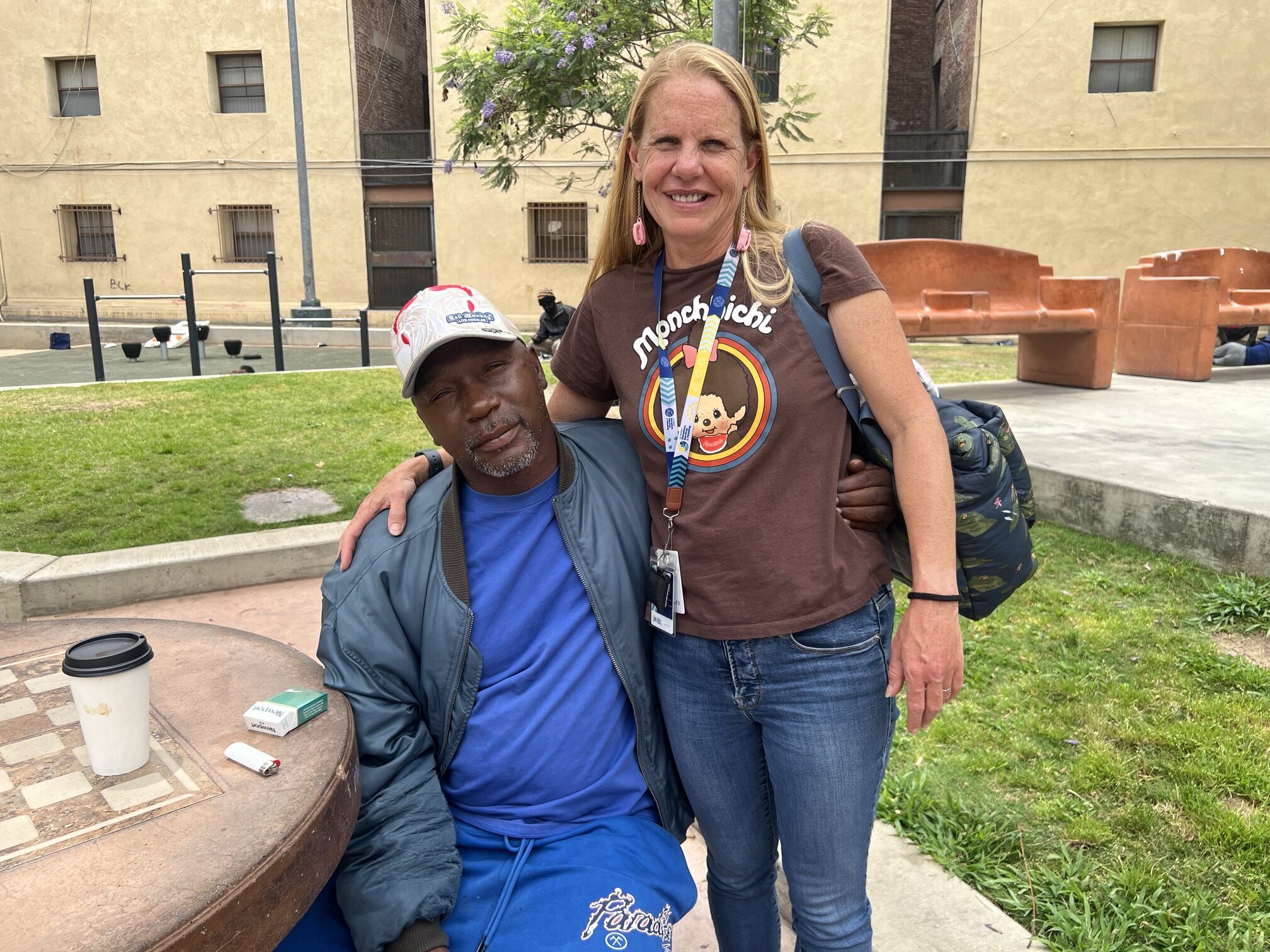
Others have taken detours on their journey from homelessness to housing.
“It takes time to engage people who have been outside for a long time,” Sieglinde says. “The longer people are out on the street, the more problems they have.”
But Sieglinde gives up on no one. She recently helped a man get into a permanent apartment on the Westside of Los Angeles after 22 years living in Skid Row. He loves the new neighborhood.