
About Measure A
Approved by LA County voters in November 2024, Measure A is a half-cent countywide sales tax that funds housing, services, and prevention programs for people experiencing or at risk of homelessness. It addresses the root causes of homelessness, strengthens collaboration across agencies implementing Measure A funding, and increases transparency and accountability.
Measure A resources supporting Comprehensive Homeless Services are largely delivered by nonprofit organizations working in every part of LA County. These services connect people to housing, mental health and substance use treatment, medical care, and resources for jobs, training, and benefits.
JUMP TO:
Funding Allocations
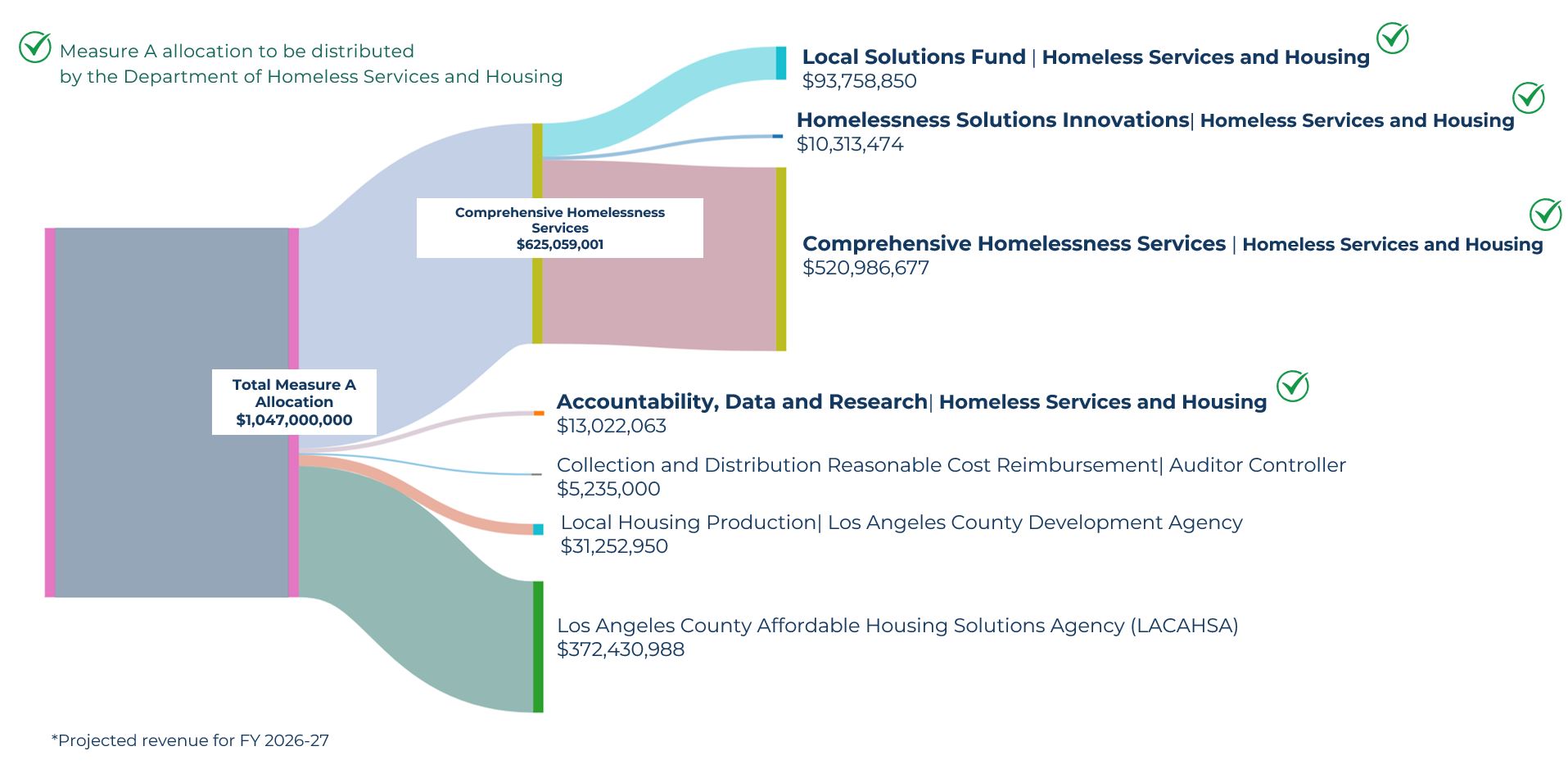
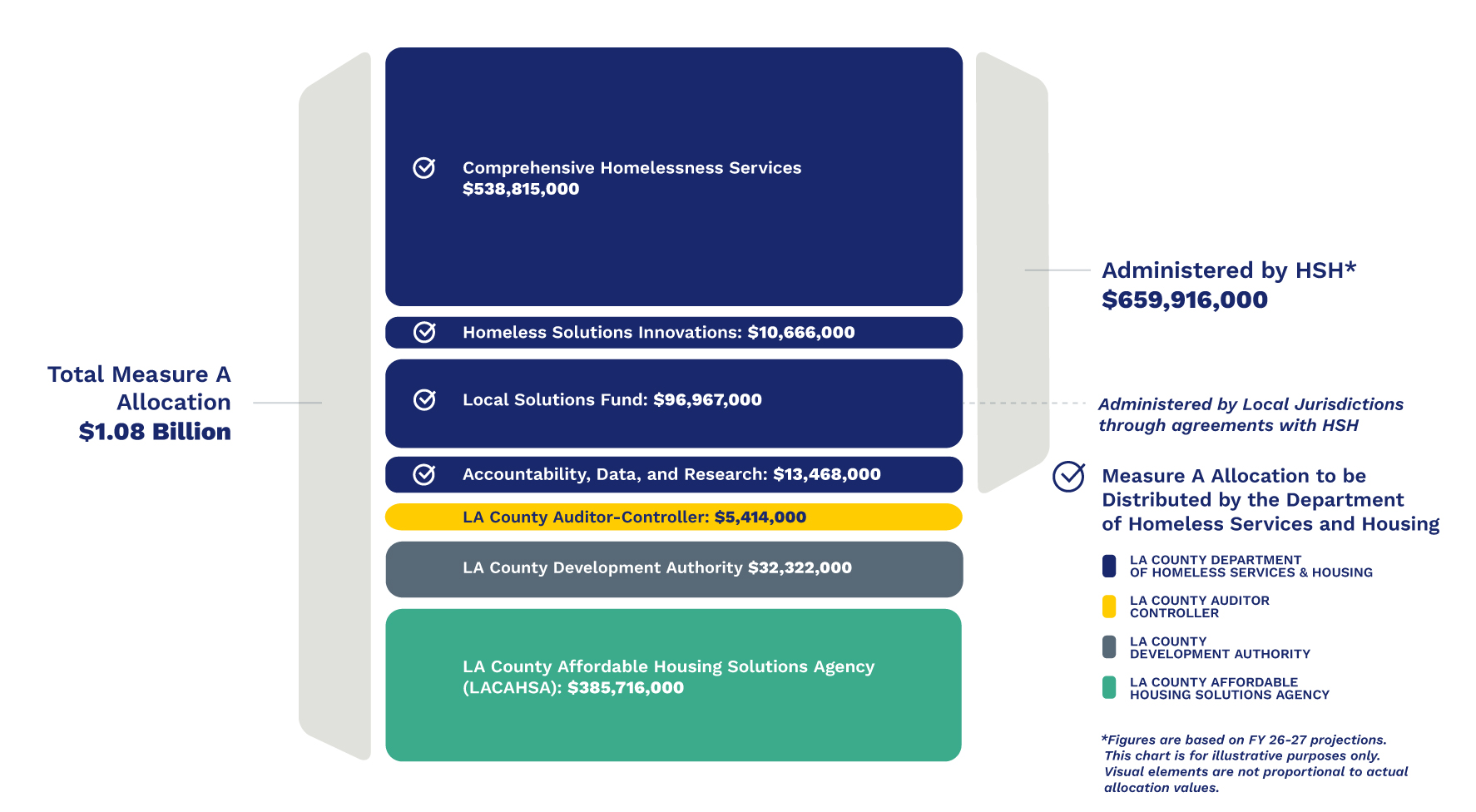
Measure A funding is shared between Los Angeles County, unincorporated areas, cities and Councils of Government, the Los Angeles County Development Authority (LACDA), and the Los Angeles County Affordable Housing Solutions Agency (LACAHSA). A percentage breakdown can be found here. Funds are allocated as follows:
Measure A Spending Plan
Spending Categories and Key Definitions
Measure A Impact
Measure A is a major shift in how LA County responds to homelessness by requiring a more coordinated and accountable system in Los Angeles County aligned with required regional goals.
These required resources track progress, measure impact, and keep the process transparent.

Measure A Goals and Metrics
The annual Point in Time Count is one measure communities use to estimate how many people are experiencing homelessness on any given night in LA County. But these estimates alone are not enough. We also need to track how well the system is reducing, resolving, and preventing homelessness.
Measure A builds in transparency by setting clear goals accompanied by metrics for how those goals will be achieved. It also requires public oversight and reporting on goal performance. These goals will help align the region’s efforts to address and prevent homelessness.
Under Measure A, LA County must:
- Set metrics for required goals at least every five years
- Provide regular oversight
- Report progress on key outcomes
- Prioritize resources based on goal performance
Goals at a Glance
Per Measure A, in March 2025 the Board of Supervisors adopted numeric target metrics, formulated by the Executive Committee for Regional Homeless Alignment (ECRHA) based on recommendations from developed by the Leadership Table for Regional Homeless Alignment (LTRHA), that align with five high-level goals in the ordinance. These metrics track progress through 2030 with annual milestones. Additionally, the Measure A goal statements were amended to include “with a focus on addressing gender, ethnic and racial disproportionality, disparities and inequities.”
Each goal includes key conditions for success and assumptions that may require adjustments to systems and policies to meet the targets. While created under Measure A, these goals guide all homelessness efforts in Los Angeles County, regardless of funding source.
Increase the number of people moving from encampments into permanent housing to reduce unsheltered homelessness with a focus on addressing gender, ethnic and racial disproportionality, disparities and inequities.
METRIC
Decrease by 30% the number of people experiencing unsheltered
homelessness from a baseline of 52,365 in 2024 to a target of 36,656 in 2030
EQUITY METRIC 1a
Decrease the rate of growth of Latinx people experiencing unsheltered homelessness from a baseline of 30% by 10 percentage points to 20% in the service data (and reduce rate of growth in Latinx unsheltered point-in-time (32%) also by 10 percentage points).
EQUITY METRIC 1a
Decrease unsheltered point-in-time by 10 percentage points for Black, Latinx, and AIAN people.
METRIC
Increase by 80% the number of people moving into permanent housing from unsheltered settings from a baseline of 5,937 in FY 23-24 to a target of 10,687 in 2030
EQUITY METRIC 1b
Reduce disparities in access to permanent housing for Black, Latinx, and AIAN people experiencing unsheltered homelessness by 10 percentage points from baselines 11% (Black), 8% (Latinx), 11% (AIAN).
METRIC
Increase by 32% the rate of people moving into interim housing from unsheltered settings from a baseline of 34% in FY 23-24 to a target of 45% in 2030
EQUITY METRIC 1c
Reduce disparities in access to interim housing for AIAN people from unsheltered settings by 10 percentage points from baseline of 42% to 52% and for Latinx people from baseline 34% to 44%.
Reduce the number of people with mental illness and/or substance use disorders who experience homelessness with a focus on addressing gender, ethnic and racial disproportionality, disparities and inequities.
METRIC
Reduce by 15% the number of people with SMI alone experiencing
homelessness from a baseline of 14,056 in FY 23-24 to a target of 11,978 in 2030
EQUITY METRIC 2a
To reduce disparities, decrease the rate of SMI or SUD (49%), SUD (8%), and co-occurring disorders (26%) by 20% for the American Indian/ Alaska Natives.
EQUITY METRIC ACROSS a, b, and c
Reduce the share of people who experience homelessness and report having these conditions within the point in time demographic surveys for Black, Latinx and AIAN people.
METRIC
Reduce by 10% the number of people with SUD alone experiencing
homelessness from a baseline of 8,697 in FY 23-24 to a target of 7,827 in 2030
EQUITY METRIC 2b
Reduce rate of growth of Latinx people with SUD or SMI (54%) by 10 percentage points, and percentage of Latinx people with co-occurring disorders (17%).
EQUITY METRIC ACROSS a, b, and c
Reduce the share of people who experience homelessness and report having these conditions within the point in time demographic surveys for Black, Latinx and AIAN people.
METRIC
Reduce by 10% the number of people with co-occurring SMI and SUD experiencing homelessness from a baseline of 20,446 in FY 23-24 to a target of 18,401 in 2030
EQUITY METRIC 2c
To reduce inequities, decrease the rate of co-occurring disorders by 5 percentage points from baseline of 18% to 13% for Black people.
EQUITY METRIC ACROSS a, b, and c
Reduce the share of people who experience homelessness and report having these conditions within the point in time demographic surveys for Black, Latinx and AIAN people.
Increase the number of people permanently leaving homelessness with a focus on addressing gender, ethnic and racial disproportionality, disparities and inequities.
METRIC
Increase by 57% the number of service participants who exit
homelessness to permanent housing from a baseline of 19,127 in FY 23-24 to a target of 30,000 in 2030
EQUITY METRIC 3a
Reduce rate of growth of Latinx people experiencing homelessness by increasing permanent housing exits by at least 57%.
EQUITY METRIC 3a
Reduce disproportionality of Black and AIAN people experiencing homelessness by increasing permanent housing exits by 65% for each group.
EQUITY METRIC 3a
Reduce disparities in outcomes by increasing the percentage of Black and AIAN people who are permanently housed and do not return to homelessness by 10 percentage points, from 73% for AIAN and 77% for Black or African American.
METRIC
Increase by 101% the number of service participants who retain
permanent housing, two years after they exit homelessness from a baseline of 10,501 in FY 23-24 to a target of 21,104 in 2030
EQUITY METRIC 3b
Reduce disparities in outcomes by increasing by 91% the number of service participants who retain permanent housing, 5- and 10- years after they exit homelessness for Black or African American, Hispanic or Latino, and American Indian Alaska Native by 2030.
Prevent people from falling into homelessness with a focus on addressing gender, ethnic and racial disproportionality, disparities and inequities.
METRIC
Reduce the number of people who become newly-homeless by 20%
from a baseline of 63,202 in FY 23-24 to a target of 50,561 in 2030
EQUITY METRIC 4a
Decrease disproportionality of newly-homeless Black or African American individuals by 30% from a baseline of 35% by 2030.
EQUITY METRIC 4a
Decrease the disparity in the rate of growth of newly homeless Black (9%)and Latinx (21%) people by 7 percentage points each.
EQUITY METRIC 4a
Reduce the overall share of homelessness within in the point-in-time count by 20% for Black or African American, Hispanic or Latino, and American Indian Alaska Native by 2030.
Increase the number of affordable housing units in Los Angeles County with a focus on addressing gender, ethnic and racial disproportionality, disparities and inequities.
METRIC
Increase by 41%-53% the current level of affordable housing
production, from a baseline of 1,700 units in FY 23-24 to a target of 2,400-2,600 units in 2030
METRIC
Increase the current level of affordable housing units being preserved, to a total of 420 at-risk units preserved annually
- Increase outreach to people experiencing homelessness earning 30% or below the Area Median Income (AMI) and severely cost burdened renter households in LA County for affordable units.
- Increase retention of Black people in Permanent Supportive Housing by targeting legacy permanent supportive buildings for preservation.
- Reduce disparities in access to high opportunity neighborhoods and increasing investment into under-resourced communities through affordable housing development.
- Increase enforcement of source of income protections to reduce discrimination in the housing market.
- Increase Flexible Housing Subsidy Pool vouchers to increase access for undocumented and documented households.
- Explore small area Fair Market Rate (FMR) to increase equity in voucher amounts.
- Use master leasing strategy to reduce challenges for people with criminal background or poor credit.
- Conduct outreach to groups with the highest rates of homelessness to access vouchers.
- Reduce disparities in homeownership by using vouchers for homeownership through the Housing Choice Voucher Program.
The documents below outline the data analysis that resulted in the trend and baseline data that were leveraged to finalize the Board adopted systemwide Goals and Metrics required by Measure A:
- Data Subcommittee Baselines Report
- Data Subcommittee Baselines Slide Deck
- Data Subcommittee Baseline Demographics Report
- Interactive Baseline Demographics Report
The following dashboards display data about how specific subpopulations experience homelessness across LA County:
The Measure A Responsive Regional Plan
Measure A requires Los Angeles County to have a Regional Plan. The Responsive Regional Plan is a public tool that shows how local jurisdictions and regional partners across the County —cities, councils of governments (COGs), continuums of care (COCs), County departments, and other publicly funded entities—are working together to prevent and end homelessness and meet Measure A goals. This comprehensive inventory of activities taking place across the County is meant to help inform regional decisions about policy and funding across all housing and homelessness efforts.
As a living tool, the Responsive Regional Plan will continue to evolve to reflect existing resources, highlight innovative programs, and encourage regional collaboration.
The Responsive Regional Plan Inventory
This interactive table displays the strategies and programs that regional partners and local jurisdictions are implementing to address homelessness and housing affordability in their communities.
- Search and filter to find specific information.
- Sort by column to organize the information by category (for example, by impact category or regional partner/jurisdiction).
- Download the data to explore it further.
As of November 13, 2025, data in the Responsive Regional Plan (RRP) will contain existing information from the following data sources: Measure A Local Solutions Fund grantees with processed executed contracts, HHAP 6 application, and data from 10 County departments/entities as well as LAHSA. Some data do not have all fields complete either because it is not applicable to the action item or it was not available at the time of submission. The current RRP is meant to represent action items occurring in FY25-26.
If public funding entities would like to add or update information in the RRP please email: RRP@hsh.lacounty.gov.
Data will be added or updated in the RRP as it is received and reviewed. Please note that requests for updates to what is publicly displayed in the RRP do not constitute changes to contracts or agreements. Please direct contract amendment requests to the appropriate party.
Funding Allocations
Measure A funding is shared between Los Angeles County, unincorporated areas, cities and Councils of Government, the Los Angeles County Development Authority (LACDA), and the Los Angeles County Affordable Housing Solutions Agency (LACAHSA). A percentage breakdown can be found here. Funds are allocated as follows: