
Forty-two people living unsheltered in the wildlands around the Whittier Narrows waterway in the San Gabriel Valley moved into safe interim housing through Los Angeles County’s most recent Pathway Home operation.
The October 1 operation focused on makeshift shelters within the sprawling Whittier Narrows, which has forests as well as stretches of uneven, hilly dirt paths and thickets of wild grass dotted with sunflowers.
People in search of shelter have tucked themselves into groves of trees, setting up tents in clearings with bedding, chairs, tables, and cooking stoves. Resourceful and inventive, they have built tree houses and hooked into electricity. At least one cobbled together a rough-hewn house with a roof, a bedroom, and tiles adorning the exterior.
Only the week before the move, Vanessa Guillen, a leader on the LA County Pathway Home team, had huddled with outreach workers and others in Whittier Narrows to praise their months of meticulous work which would culminate in housing for many of the people they had shepherded.

LA County Homeless Initiative analyst Vanessa Guillen speaks during a briefing before a Pathway Home operation in the Whittier Narrows, Wednesday, Oct. 1, 2025. (Photo by Michael Owen Baker)
“We know without the resources we have brought to Whittier Narrows, these individuals would not even be offered housing,” she said. “They are the ones that are not seen, because they are in the riverbed, they are in between bushes and trees.”
Now many are ready to move on. ‘‘When you have somewhere safe to live you can rest, you can get a better job,” a man named Felipe told Guillen the week before the October 1 move. “If you can do that, you will be my angel.” (He got a motel room.)
Their backstories are often about what they have lost—jobs, housing, loved ones.
Liliana and Jonathan

Jonathan and Liliana stand with their cats “LT” and “King” in their interim housing in El Monte during a Pathway Home operation, Wednesday, Oct. 1, 2025. (Photo by Michael Owen Baker)
Liliana, 44, and her partner, Jonathan, 35, had bounced around from place to place, sometimes indoors, sometimes living outside. Liliana has been homeless for years, grappling with severe depression after her 15-year-old daughter died by suicide, she said. The couple found something of a home in the Narrows where other people helped them get situated. They draped their makeshift shelter in a dusty clearing with tarps for shade. After they got a cat, the rats that had scratched at their tent vanished. Now they have two cats–a Lynx Point Siamese named LT and a traditional Siamese named Elvis.
When they first met Kiowa Torkay, a LAHSA outreach worker, “we were still iffy” about moving out, said Liliana. But Torkay—who brought them cat food—got to know the couple. Eventually, they said yes to moving. In fact, they were so committed that when they left for a quick errand the day they knew Torkay would come by for them, they taped a note on a board at the entry to their campsite assuring her they would return:
 “Went to the restroom.
B right back. 9:40am
Thank you
Liliana & Jonathan”
“I like to think that hope never goes away,” said Torkay, who has been an outreach worker for LAHSA for six and a half years. “It’s a matter of timing. Are they ready to make that change? You always hope they’re ready the first day but sometimes they’re not. Sometimes it takes building that relationship with them.”
Robert and Raymond

Robert talks with LAHSA outreach worker Kiowa Torkay before moving into interim housing during a Pathway Home operation in the Whittier Narrows, Wednesday, Oct. 1, 2025. (Photo by Michael Owen Baker)
Robert, 39, described the Whittier Narrows community of campers as close-knit and helpful to each other. He heard about the Pathway Home program from his younger brother Raymond, he said. “That was what got me into it. I’m glad they were able to take me today,” said Robert on October 1, as he propped a box on one shoulder and prepared to move.
He hopes to get another job again. “Honestly it’s hard out here,” he said noting that he hoped the Pathway Home program would help him restart his life. “It’s hard to do anything right here when you have no shower, no steady place to sleep, and you don’t know what time you’re going to go to sleep because it’s too cold one night.”
Robert’s younger brother Raymond, 28, walked through a break in a thicket of grass, holding bottles of water.
“I didn’t necessarily mind living like this,” Raymond said. “I’ve been camping my whole life.” But eventually the life proved arduous. “It gets tiring out here. Everything is a mission.”
He added, “The day-to-day routine is you wake up, you get your area together, you go get your food—either by buying it or stealing it. Everything is on a day-to-day basis. There’s no longevity.”
So Raymond, who says he went to community college in Los Angeles, is trading camp life for a motel room.
Hernan

Hernan sits on the bicycle he built outside his interim housing in El Monte during a Pathway Home operation, Wednesday, Oct. 1, 2025. (Photo by Michael Owen Baker)
It took Hernan, 39, a little longer to make up his mind to leave when outreach workers first came by and offered him help. “I was not going to take it because like I told them ‘I don’t think I need the help. I can get a place if I want a place. I’m not ready to be indoors. This helps me.’” Living in nature, he said, helped him heal after the violent death of his younger brother.
But on the day of the move, he and his French bulldog, Frenchie—who faithfully follows him everywhere—were ready and packed for the move. He rode his specialized souped-up bike into his motel courtyard with Frenchie on his lap.

Hernan holds his dog “Frenchie” in his interim housing in El Monte during a Pathway Home operation, Wednesday, Oct. 1, 2025. (Photo by Michael Owen Baker)
Ernesto

LA County Sheriff’s Deputy Carlos De La Torre stands with Ernesto who agreed to move to interim housing during a Pathway Home operation in the Whittier Narrows, Wednesday, Oct. 1, 2025. (Photo by Michael Owen Baker)
Ernesto, the 65-year-old architect and builder of a makeshift house that County outreach workers and a sheriff’s deputy working with him had marveled at, was finally ready to move out. He has chronic arthritis in both knees, he explained. “Walking up and down—it’s hard for me,” he said.
Sheriff’s Deputy Carlos De La Torre, a member of the department’s Homeless Outreach Services Team (HOST) has known Ernesto for three years. The day that Ernesto collected his belongings to leave, De La Torre stood in front of the house Ernesto had built and shook his hand exuberantly. “You did it, bro!” De La Torre exclaimed.
—
This operation was the 66th overall Pathway Home encampment resolution since the Los Angeles County Homeless Initiative launched the program in August 2023. Nearly 1,800 Los Angeles County residents have come off the streets through Pathway Home. Of those, more than 400 are now permanently housed. These operations have also removed more than 1,000 RVs from the streets.
This effort came together in partnership with Supervisorial District 1, along with LAHSA; the LA Sheriff’s Department’s HOST teams; the County Departments of Mental Health, Health Services, and Animal Care and Control; the Emergency Centralized Response Center; Helpline Youth Counseling; Volunteers of America Los Angeles; and Union Station Homeless Services.
Previously, outreach teams working in Whittier Narrows since April moved more than 40 other individuals living unsheltered there into interim housing.
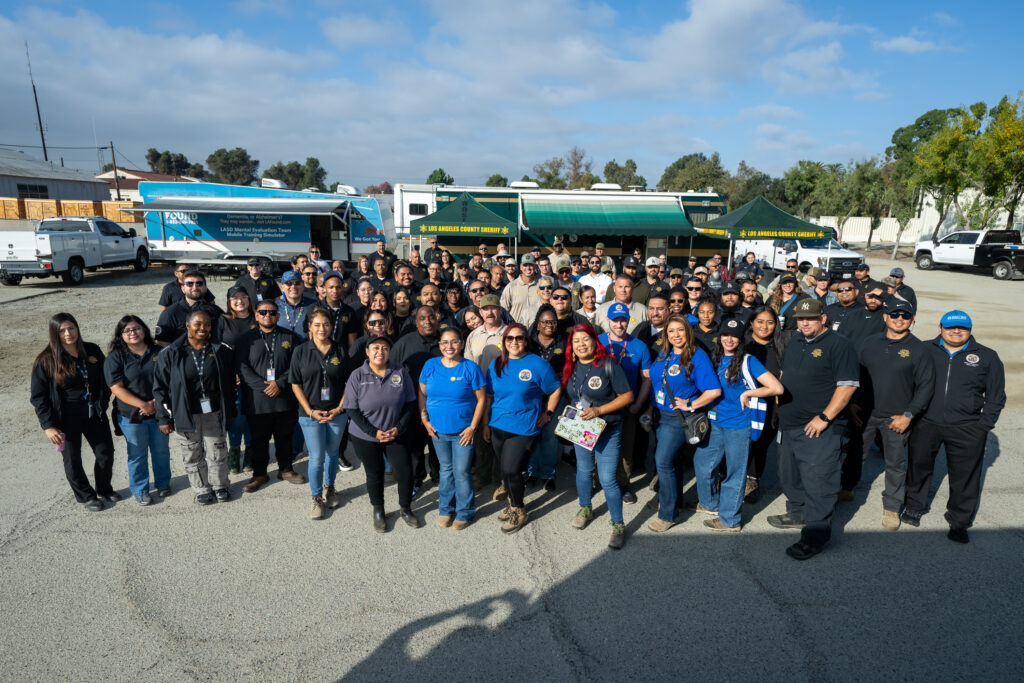
Group photo before a Pathway Home operation in the Whittier Narrows, Wednesday, Oct. 1, 2025. (Photo by Michael Owen Baker)