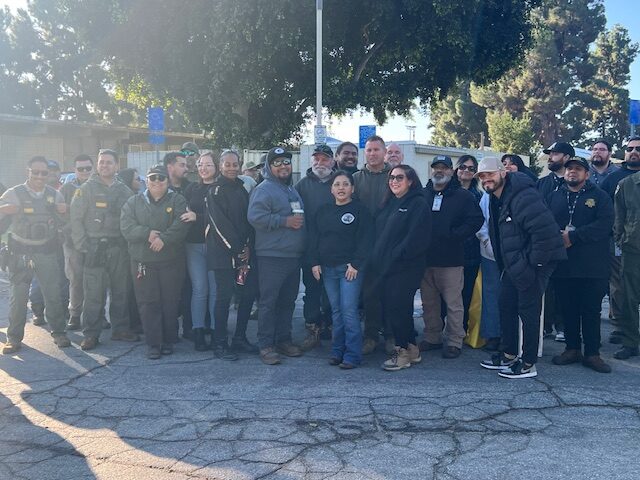
Los Angeles County’s Pathway Home operation in late November brought 20 unhoused people into safe interim housing where they can begin their journeys out of homelessness. The move, funded by a state Encampment Resolution Fund grant, took the Pathway Home team into unincorporated Willowbrook, Lennox, the City of Inglewood, and unincorporated Athens.
Vanessa Guillen of Pathway Home gazed out over the crowd of workers in George Washington Carver Park who would fan out that morning to bring people inside and acknowledged the impact of LAHSA outreach workers.
“Outreach through LAHSA and LASD,” Guillen said, also referencing the LA Sheriff’s Department’s Homeless Outreach Services Team, “is the secret sauce that makes Pathway Home. We cannot do this without the amazing partnership that we have with you all and the amazing work we’ve seen you do every day, no matter what’s going on. You guys always find time and compassion to reach out to our unhoused neighbors and get what their needs are and talk to them and establish a relationship.”
On a wide swath of green along a quiet street in Willowbrook, about a half dozen people were gathering their belongings and preparing to leave their tents. Jerrikk, 54, had packed up belongings from his white tent, leaving behind things that got wet in the recent rainstorm. He took matching pants and shirts, he said. He had been in the tent for two years. From there, he could see the street where he grew up.
His backstory included a job at one point—working in an oil refinery as a bolt technician. He has been homeless for 10 years—two of those in this tent, which he moved around as sanitation workers cleaned the areas wherever he was staying. The elements could be harsh: “When it’s hot, it’s hot. When it’s cold, it’s cold,” he said. Now he had a chance to leave for something more promising.

“I want to go to truck driving school,” he said.
A sheriff’s deputy from the HOST team wished him luck.
“They’re very cool if you’re not doing a crime,” Jerrikk said of the deputies.
“Ready?” said Ulises Garcia, a LAHSA HOST Supervisor.
“Ready,” said Jerrikk.

Not so ready early that morning was Camila, dressed in a plaid jacket and leggings, who was still packing up her belongings when the outreach workers arrived.
Camila does construction work and had returned home late from work the night before and started packing with a flashlight in hand. “I work for everything I have,” she said.
Camila neatly piled her bags and suitcases on a cart, relieved that she was granted a little extra time to finish compiling her belongings. “If you see my stuff, it’s not trash,” Camila said. She called her brother to drive over from Santa Monica and take some of it.
“I just ended up over here because I went through a divorce,” Camila, 45, said. “But as long as I have a job, I’ll be okay.” Rents, she said, even for rooms in houses and studio apartments were too high once you added first and last months’ rent and a security deposit.
Back at the staging area in Carver Park, Jessica and her husband waited to be ferried to their motel. They had moved around, staying with friends and family before they found vehicles they could stay in at night. Various owners would let them stay in the back of a U-Haul for a while and a van for a month. A police officer in Inglewood helped connect them to outreach workers.
“We call him Inglewood Jesus,” Jessica said.
At the motel, Jerrikk was settling into his room. “When you’re somewhere new, you’re thinking new,” he said.
Camila, too, was taking in her room that had “everything from a microwave to a fridge to a bed.” She told the HOPICS staff managing and providing onsite services at the motel that she would need to sometimes travel for her construction work and would be happy to provide them with a letter saying so.
Residents living in the motels are free to come and go, and service providers check on them each day. Rosie Atkins, the HOPICS program manager for the motel, said, “We’re not going to take away work. That’s the number one goal for financial stability.”
Not far from their rooms was Jonnine, 43, who had been homeless for 10 years, living in a tent, when outreach workers brought her clothes and blankets and eventually moved her into this motel earlier this year. “I have nothing but good things to say about them, especially my case manager. He’s not judgmental. He gives you his opinion, but he gives you help.”
She is applying for permanent housing—an apartment for her and her two dogs. “I can’t wait to have my housewarming party,” she said.

In addition to LAHSA, the LA Sheriff’s Department HOST, and HOPICS, this Pathway Home operation was aided by the LA County Departments of Public Health, Mental Health, Health Services, and Public Works.
This operation was the 69th overall Pathway Home encampment resolution since the Los Angeles County Homeless Initiative launched the program in August 2023. More than 1,800 Los Angeles County residents have come off the streets through Pathway Home. Of those, more than 450 are now permanently housed. These operations have also removed more than 1,000 RVs from the streets.