
Outreach and Engagement for ICMS
This resource offers trauma-informed, participant-centered strategies for building trust, conducting outreach, and navigating engagement challenges in ICMS. It brings together HFH core principles, best practices, and actionable tools for real-world field work.
ICMS and outreach begin the moment a participant enters a CHAMP slot.

Rooted in HFH Core Principles
Every outreach and engagement interaction should be grounded in these six principles. They are not abstract values — they are practical standards for how case managers show up for participants every day.
Participant-Centered
Meet people where they are. Prioritize their experiences, needs, and preferences above all else.
Trauma-Informed
Respect, empathy, individualized, non-judgmental, non-coercive. Instill humanity in people who may have lost faith in themselves.
Harm Reduction
Focus on increasing safety and comfort without requiring abstinence or preconditions for service.
Housing First
Connect participants to permanent housing as quickly as possible without barriers or preconditions.
Equity, Diversity, Inclusion, Anti-Racism (EDIA)
Promote fair treatment and full representation, especially for historically marginalized groups.
Whatever it Takes for as Long as it Takes
Ongoing, collaborative efforts to support case complexities — no giving up.
Outreach Action Steps
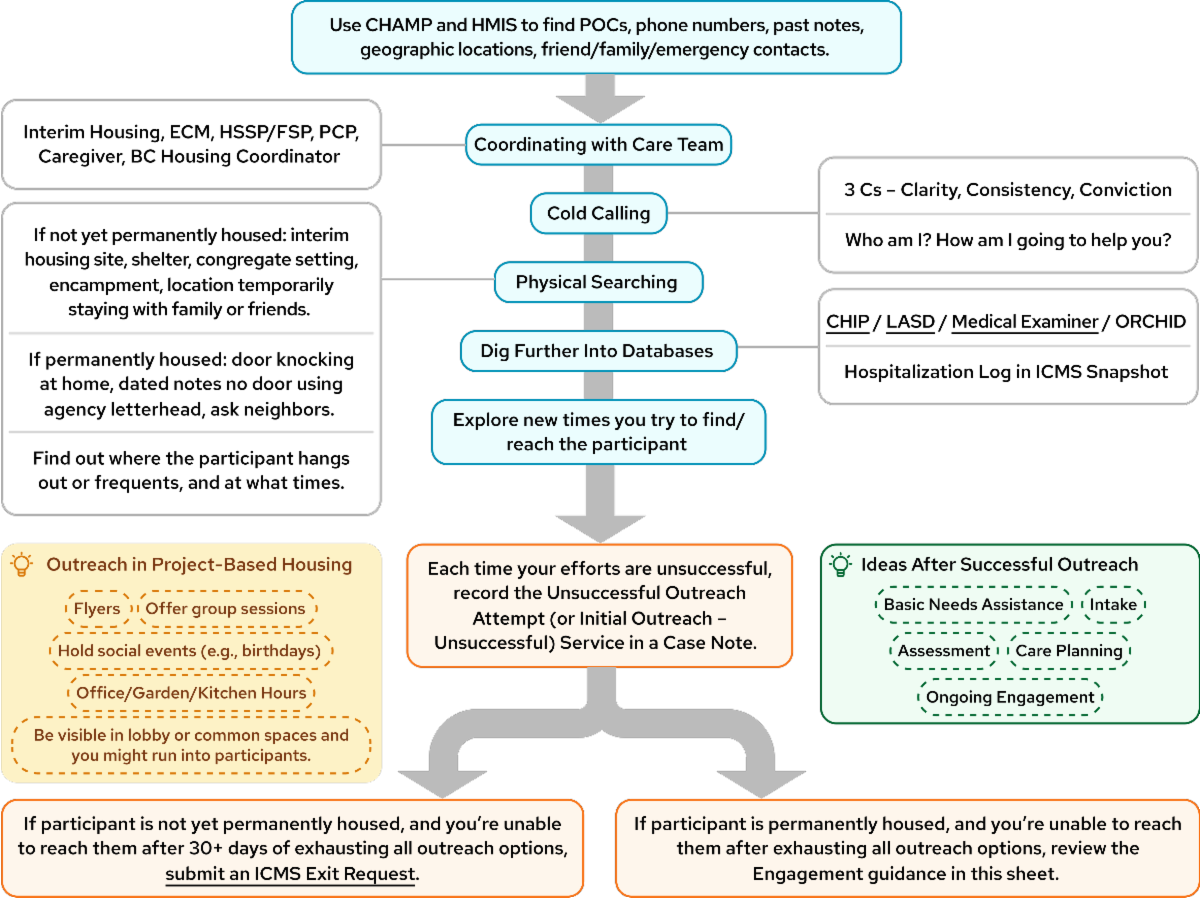
Use these action steps to locate and connect with participants who are hard to reach. Start with CHAMP and HMIS to find POCs, phone numbers, past notes, geographic locations, and friend and family emergency contacts.
Tip: Write quick bullets in a notebook summarizing encounters, then use them to write full case notes later. ICMS and outreach begin the moment a participant enters a CHAMP slot.
Coordinate with Care Team
Contact: Interim Housing, ECM, HSSP/FSP, PCP, Caregiver, and BC Housing Coordinator to locate the participant and gather information.
Cold Calling
Use the 3 Cs — Clarity, Consistency, Conviction. Lead with: “Who am I? How am I going to help you?”
Physical Searching
- If not yet permanently housed: interim housing site, shelter, congregate setting, encampment, or location temporarily staying with family or friends
- If permanently housed: door knock, leave dated notes, ask neighbors
- Find out where the participant hangs out or frequents and at what times
Dig Further Into Databases
- CHIP
- LASD
- Medical Examiner
- ORCHID
- Hospitalization Log in ICMS Snapshot
Explore New Times to Try
Try reaching the participant at different times of day, different days, and at different locations. Keep exploring until you make contact.
Outreach in Project-Based Housing
- Flyers
- Offer group sessions
- Hold social events such as birthdays
- Office, garden, or kitchen hours
- Be visible in lobby or common spaces
Safety Tips for Field Outreach
- Be sensible
- Use a buddy system in encampments
- Try meeting in public spaces if concerned about safety
- Do not keep your back to a wall
- Always make sure you have a route out
- If you do not feel safe, walk away
Unsuccessful Outreach
Each time outreach efforts are unsuccessful, record the Unsuccessful Outreach Attempt (or Initial Outreach — Unsuccessful) service in a Case Note.
- If the participant is not yet permanently housed and you are unable to reach them after 30 or more days of exhausting all outreach options, submit an ICMS Exit Request
- If the participant is permanently housed and you are unable to reach them after exhausting all outreach options, review the Engagement guidance in the Follow-Up and Re-Engagement tab
Outreach Action Steps Flow Diagram
Follow-Up and Re-Engagement
When a participant disengages, consistent and compassionate follow-up is the foundation of re-engagement. Start simple, layer over time, and always center the participant’s experience and preferences.
Tip: Have a coffee together or meet at a fast food spot. For many housing vouchers in our program, participating in ICMS is a requirement. Exit may not be an option when challenges arise.
It Takes a Village
- Collaborate with the Care Team: HSSP/FSP, ECM, Caregiver, BC, PCP, and IH
- Involve friends and family wherever possible to build community
- By engaging more in their community, others engage more with the participant
All Action Steps Should Be Participant-Centered
- You do not know where someone is at until you actively listen to them
- Speak eye-level — do not stand over them
- Believe participants and validate what they are saying
- No shame and no blame
- Focus on participant self-care
- Ask how you can help rather than assuming what the participant needs
- Put yourself in their shoes — what would I need in this situation?
- Regularly check your own motives
Start Simple and Layer Things Over Time
- Surface level interactions with consistency can lead to deeper conversations
- Prioritize safety and comfort first, then work on more later
Be Transparent, Genuine, and Clear
- Make it clear what you can and cannot do in your role
- Operate with emotional intelligence and care
- Be concise and avoid using words people may not understand
- Emphasize mutual respect and set boundaries
- Do not overpromise — keep asks and offers limited
- Always confirm the date and time of the next scheduled meetup
Collaborative Care Planning
- Support participants in taking an active role in their well-being and empowering themselves to make informed decisions
- The participant is the best at driving their care plan — you are just along for the ride. Respect individual choices.
- A good care plan includes a housing goal, an income goal, a health care goal, and a fun goal
- Foster a sense of hope — celebrate accomplishments and progress
Offering Items and Basic Needs Resources
Basic needs items to bring or offer:
- Hygiene kit, bottle of water, hand warmers, blanket, chips, socks, goody bag, clothes, laundry money, food from food bank
- Notebook, clock, watch, pens
- Harm reduction: naloxone, pipe tips, needle exchange
- Resources for children: school, supportive services, clothes, supplies, toys
- Resources for pets: pet food, vaccinations, spay/neuter, grooming, adoption, collar, leash
Navigating Engagement Challenges
Every case manager will encounter participants who reject help or respond with hostility. These situations are not failures — they are opportunities to respond with skill, empathy, and consistency. It is always okay to ask for help.
Important: If conflict escalates, ask your clinical supervisor for guidance and submit a PH² referral. It is always okay to ask for help.
Rejection or Disengagement
Participant refuses help or withdraws. Explore why: trauma, mistrust, health issues, fear of domestic violence, trafficking, or past harm, or misunderstanding your role.
Respond with:
- Lower your tone
- Clarify your intent
- Look for openings such as SMART goals and safety check-ins
Rude or Hostile Behavior
Participant is being aggressive or confrontational. Use empathy — this is likely driven by trauma or injury. Stay calm and do not personalize it.
De-Escalate:
- Acknowledge frustration
- Lower your tone
- Share grievance policy
- Redirect the conversation
- Reinforce mutual respect
- Step away if needed
Engagement Challenges Flow Diagram

Ongoing Training and Clinical Supervision Are Vital
All case managers should access ongoing training and clinical supervision to build skills, prevent burnout, and navigate the complex challenges of ICMS field work. HFH provides structured training opportunities and process groups to support staff well-being and professional growth.
Note: We value the incredible work you do. It is always okay to ask for help.
Key Training Topics
- Access HFH Process Groups and Crisis Intervention Training
- Maintaining healthy boundaries to prevent trauma and burnout
- Recognizing and managing transference, grief, and personal triggers
- Effective diffusion and redirection techniques
- Navigating rejection, disengagement, and disrespect
- Practicing cultural humility and responsiveness
Engaging Participants Who Are Reluctant to Participate
- Ongoing contact and documentation are vital
- Record all outreach attempts accurately, including unsuccessful ones
- Effective diffusion and redirection techniques are essential skills
- Navigating rejection and disrespect requires ongoing support and supervision