
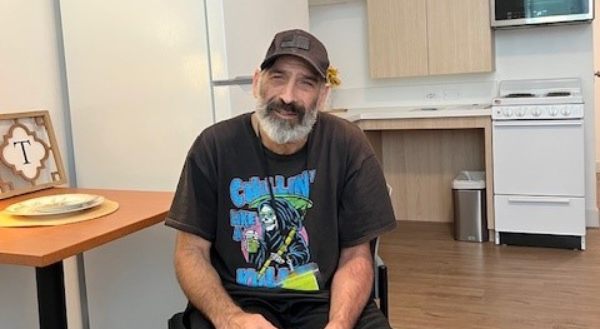
A 59-year-old formerly homeless military veteran who went from surviving unsheltered to interim housing in a Monrovia motel finally walked into an apartment of his own in early November. The move took collaboration and hard work from a dedicated group of people from the Los Angeles County Department of Military and Veterans Affairs (MVA), the LA County Pathway Home program, the U.S. Department of Veterans Affairs, and the LA County Sheriff’s Department Homeless Outreach Services Team known as HOST.
Julie Jimenez, the administrative services manager for the Homeless Services Division at MVA, had met Garabed–or Gar as he prefers to be called—when he moved into the Monrovia motel through the Pathway Home program. LA County’s signature encampment resolution program, Pathway Home connects people experiencing unsheltered homelessness with immediately available interim housing accompanied by supportive services, and, ultimately, safe, permanent homes. Jimenez was the service provider’s program manager at the motel at the time. Later when she changed jobs and began working for Military and Veterans Affairs, she was determined to find housing for Gar and other veterans.
Jimenez had developed a rapport with Gar that lasted through his stay at the motel, which was prolonged by a traumatic brain injury he suffered when he had a seizure and fell, hitting his head. After being hospitalized, he spent two months in recuperative care before returning to the motel. Eventually Jimenez found him permanent housing in a West Los Angeles apartment building that provides housing for formerly homeless senior adults, half of whom are military veterans.
Finding the right place and the right resources requires “a lot of thinking outside the box,” she said.
When Jimenez got to MVA, she reached out to county officials to find out how many veterans were in interim housing through the Pathway Home program. She decided, “We’re going to reach out to each one of them, one by one and ask them what they need. Do we need to get them housed? Do they need claims? Do they need to increase their income?”
Hours before Gar moved in, Jimenez along with MVA colleagues Tanisha Rogers and Michele Felix—both service veterans, themselves—wheeled in carts of supplies filled with bedding, decorations, and bright sunflowers for his studio apartment.
“We’re in this until we decorate his home,” said Jimenez.
Oteka Macklin, a clinical therapist at the U.S. Department of Veterans Affairs in Los Angeles, screened him for the HUD Veterans Affairs Supportive Housing (VASH) program, which provides vouchers to subsidize housing. “He’s sweet as pie,” said Macklin who had met with him at the West LA VA. “He talked about his mom. He’d been through a lot. He’d lived in a park.” An apartment building will be a completely new environment for him, she said. “I’m going to keep a close eye on him.”
Gar arrived at his new home with a contingent of specially-trained sheriff’s deputies–from the HOST program—who are also veterans themselves and work with homeless veterans. They helped carry his belongings up the sidewalk.
“I’m excited and nervous at the same time,” said Gar as he walked in with a backpack. “This is an ‘I’ll believe it when I see it’ type of thing. I think I’m seeing it.”
One sheriff’s deputy who accompanied Gar from the motel said he had been slow to pack up, worried that this move wasn’t for real. The deputy reassured him that it was: “I said, ‘Now we have a place to take you. We’re all vets, we’re all brothers, we’re not lying to you.’”
John D. Strosnider, Sheriff’s Department Sergeant and a military veteran on HOST, called the day “a full circle moment” for Gar moving from homelessness to permanent housing “where we know that he will be a success and continue this journey… And be fully embraced by the community where he wants to live.”
When Gar walked into his apartment, it was already transformed into a cozy home. A crisp bedspread adorned the bed. A small table by the wall was set with plates and a sign propped up against the wall proclaiming, “EAT.”
Gar loved the ocean. “I wanted to be an oceanographer,” he said.” So, he joined the Coast Guard at 17. He was honorably discharged several months after he entered.
After that there was a contract job doing IT work for a bank near Sacramento, which he said he lost when his employer was bought up by a bigger bank. Marriage was followed by a child and a divorce. A house was bought then lost. Eventually, he became homeless. For a while he slept in a small cemetery before making his way down to Los Angeles to stay with his mother and stepfather, but that didn’t work out. For a while, he slept in a breezeway next to a community center in Monrovia.
“Eventually, I want to move back up north and open my door and see trees and not buildings,” Gar said.
The plastic green dinosaur Gar found when he was living at the motel in Monrovia is now perched on top of his refrigerator, ready to go wherever their journey takes them.