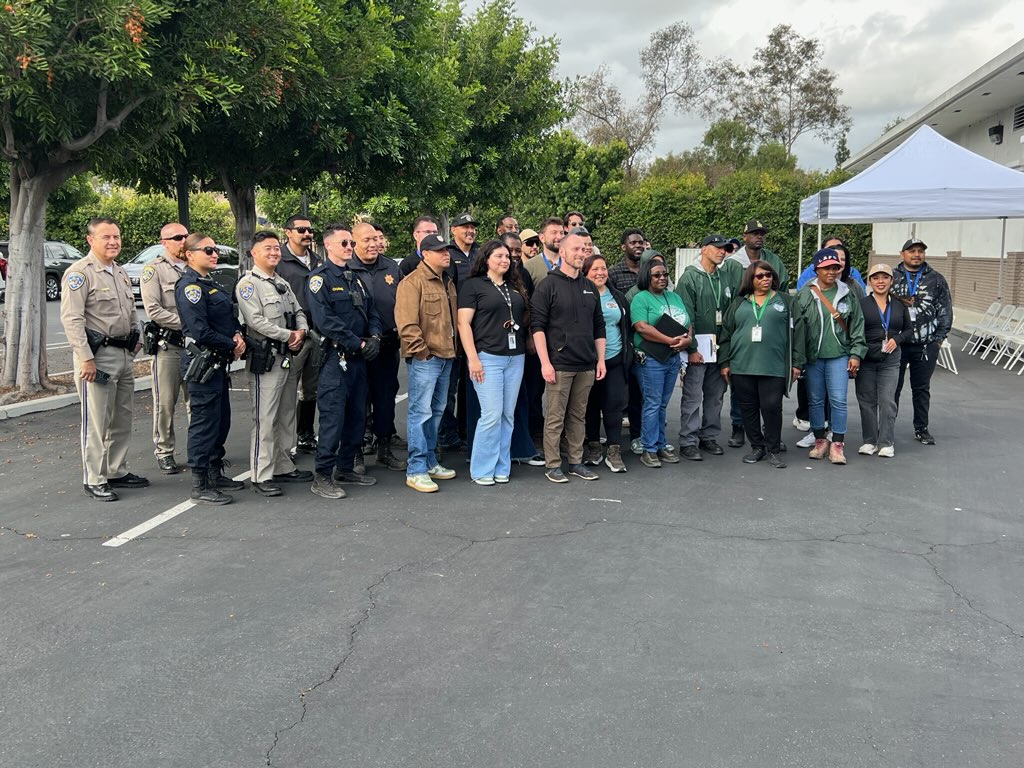
A Los Angeles County Pathway Home operation moved 29 people from encampments into safe interim housing where they will receive supportive services and be launched onto a pathway to permanent housing.
On operation day, which took place in late May, most of the 29 were busy moving their belongings and nurturing various dreams — becoming a chef, returning to a career as a carpenter, or finishing school among them. Outreach workers from the nonprofit St. Joseph Center and the Los Angeles Homeless Services Authority (LAHSA) had spent weeks working with people in the encampment along the 405 freeway.

Gisell knelt on the ground to finish packing. Her Chihuahua, Chiquitina, poked her head out of a knapsack on Gissell’s back.
Gisell, who is 36, has spent a lot of time being homeless. “Going on five years out here,” she said.
The tasks of everyday life — showering, finding drinking water — had become arduous. It may not rain much in Los Angeles, but when it does and you live outside, it’s oppressive. “I’m just tired of it,” she said.
About a year ago, she was sleeping inside her tent when “someone set my tent on fire,” she said. She escaped and soon got another tent. She moved around from one location to another. “It was kind of traumatizing,” she recalled of the days after the fire. “I couldn’t sleep for the first week.”
Now she had an offer of safe interim housing that would allow her to put behind her moving from location to location. Before she was homeless, she said, she worked at McDonald’s. Now she wants to finish her high school education and figure out what kind of work to pursue. “I like doing nails,” she said.
The encampments, some tucked behind a wall that overlooks the freeway, were in three distinct areas that run along a Caltrans embankment from Inglewood on the south end to Los Angeles on the north end. Everyone leaving the south end walked their belongings over to a nearby private parking lot where they would be checked in by Pathway Home staff and get a ride to their interim housing site.

Jonathan, 48, a carpenter, had all his tools stolen several years ago. Then, his truck broke down, and he couldn’t get it fixed. He was living with his mother for the last few years before she moved in with his grandmother in another county. “I’m sure they would have made room for me, but I didn’t want to burden them,” he said. “And I didn’t know the area. I wanted to get back on my feet. But it’s hard.”
He stood on the sliver of sidewalk next to an entrance to the 405 freeway near LaCienega Blvd. “And here we are,” he said.
Jonathan has been homeless for about a year. “I don’t want to be on the street,” he said, adding that some people he had seen had mental health issues and others, like him, were looking for a way back into a life with a job and a home. “They want to get back working,” he said. “They want to get out of the street. It’s not ideal.”
On this day, he was moving into interim housing and helping others from the encampment cart their belongings out. He was also making plans. He took courses at two community colleges in the past, he said, and he’d love to go back. He’s interested in archaeology. But he would also like to return to carpentry. “That would be the easiest way to move myself into a normal life.”
Dwayne, 47, has been homeless since 2015, he said. He’s been at the encampment on the embankment off and on for about half a decade. “I thought, ‘I’ve got to stop calling myself homeless, because I have a place to go with people who know me and people I care for.’ Being right here, it’s kind of like a community.”
Yet he experienced the ultimate in vandalism recently. He was having lunch with someone on one side of a wall that runs through the embankment when they saw smoke. “We thought it was a car on fire on the freeway. But then it seemed too close. Someone came by and said, ‘Your tent is on fire.’”
“I lost everything,” Dwayne said looking down at his stained white pants. “I’ve been in these same pants for four days. Someone gave me this backpack.” He lost prescription medications as well.

But today, he was leaving behind the tattered remains of the tent and moving into a motel room. He also wants to get into a culinary program that St. Joseph offers, he says. One of his daughters who went to a culinary school is now seeking work as a private chef, he said. “Since I was a single father, I used to prepare all their meals. She made the comment that she was taking after her father,” he said with a smile.
When you tell him that you hate to cook, he walks you through a simple recipe for bell peppers stuffed with sauteed ground turkey. He suggests mixing in a little cheese and topping the peppers with some breadcrumbs. “Make sure you bake them until the breadcrumbs get crispy”, he advised.
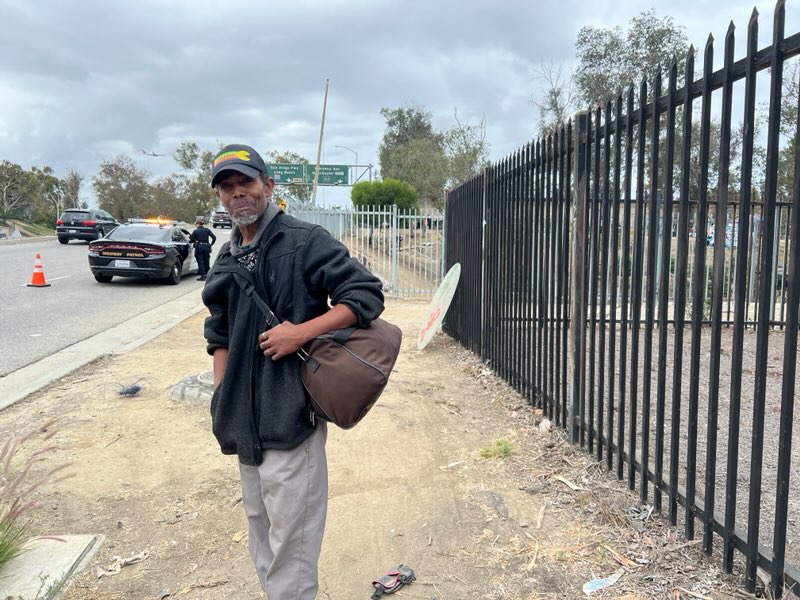
Many people leaving the encampment filled huge plastic bags with all their possessions and pushed them in shopping carts around the corner to the parking lot to wait for rides to their new interim housing. But after six years of homelessness–one and a half of those years in this area near the freeway–Ardie, 46, took nothing more than a roomy overnight bag, the strap of which he slung crossbody over his chest.
He and his wife split up years ago. “Me and my wife had our differences with each other,” he said. “I felt like I needed to be a better man. We were not getting along.”
He moved out of their house, he said, and stayed at friends’ homes—and for a week or two, a friend’s truck. “Then I slept outside,” he said. “Thankfully I had a job at 7-11. They were willing to help me.” He took out the trash, picked up food that had expired, and did other tasks.
The first time he was approached by outreach workers, he wasn’t sure he wanted to engage. “I was trying to live off the grid,” he said. Then, he would move around and lose touch with the outreach worker who had initially engaged with him.
But a friend who had already moved from an encampment to a motel room told Ardie how much she liked it. “She said it’s more comfortable inside — you can still move around outside. She just broke it down to me. She has cats. She’s happy.”
He accepted the offer to move inside. “It definitely is time,” he said.
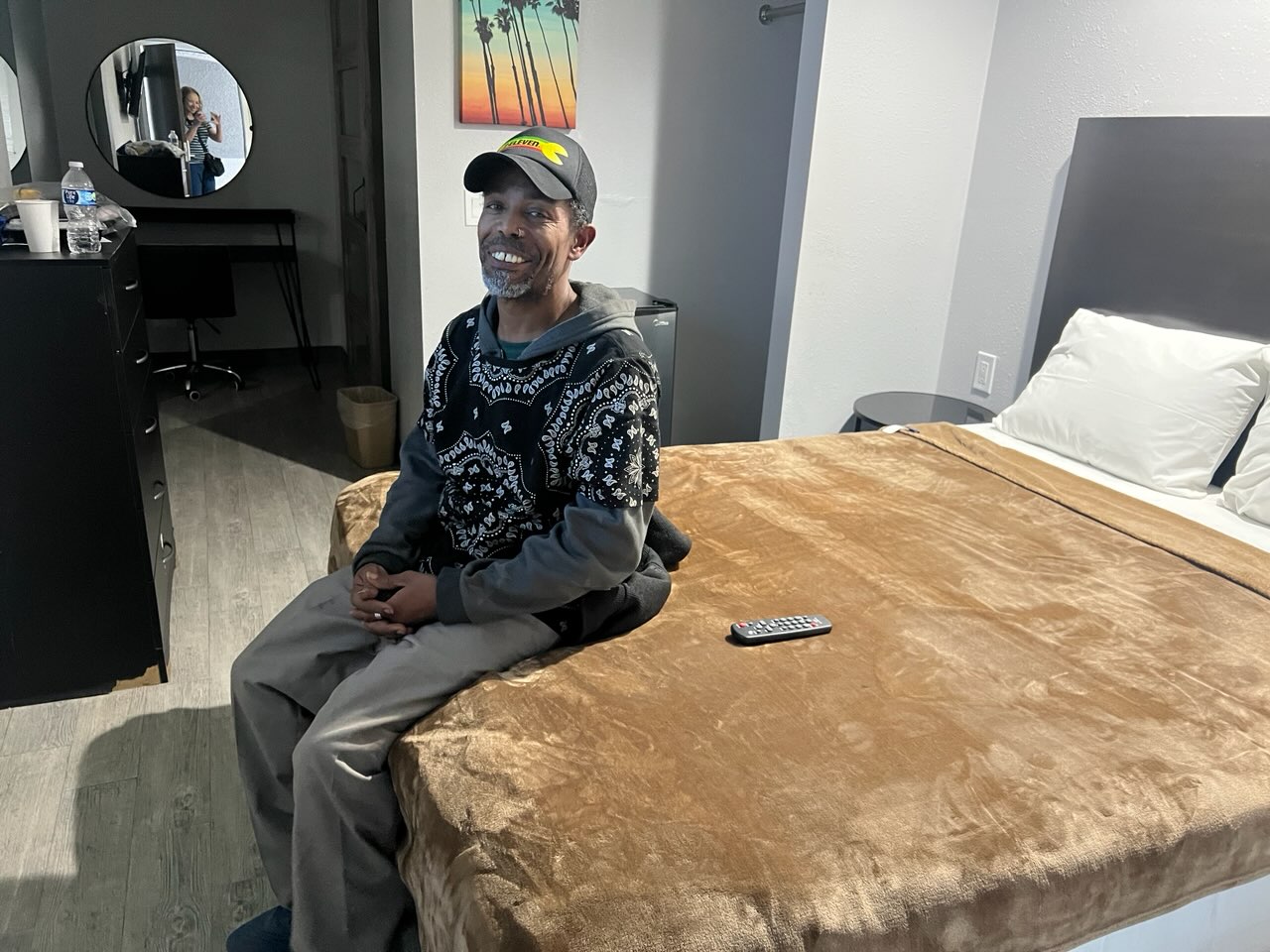
As he walked away from the embankment where he had lived for more than a year, Ardie mused on what it might be like to live in a motel. “Kind of different having four walls,” he said. “I’ve got no walls now.”
A few hours later, Ardie had his four walls.
—
All of this was made possible by a mix of organizations and agencies working together to bring people inside and connect them with the services they need to thrive. They are: the Department of Homeless Services and Housing; LAHSA; St. Joseph Center, Caltrans, PATH, HOPICS, the Office of Supervisor Holly J. Mitchell, the Office of Los Angeles City Councilmember Traci Park, the Inglewood Police Department, the city of Inglewood, the California Highway Patrol, and the LA County Departments of Mental Health and Animal Care and Control. This operation is part of the County’s multi-year initiative funded by a $51 million Encampment Resolution Fund (ERF) grant providing resources and housing to people in encampments along state highways and the Los Angeles and San Gabriel rivers.