Substance Use Care Navigation
This resource supports ICMS case managers in helping participants who use substances access person-centered information, resources, treatment, and support. It covers harm reduction, SUD treatment, recovery pathways, and LA County’s CENS services.
Substance Use Terminology
Understanding these terms helps case managers communicate clearly with participants and clinical partners, identify appropriate supports, and navigate the SUD system of care with accuracy and compassion.
Substance Use
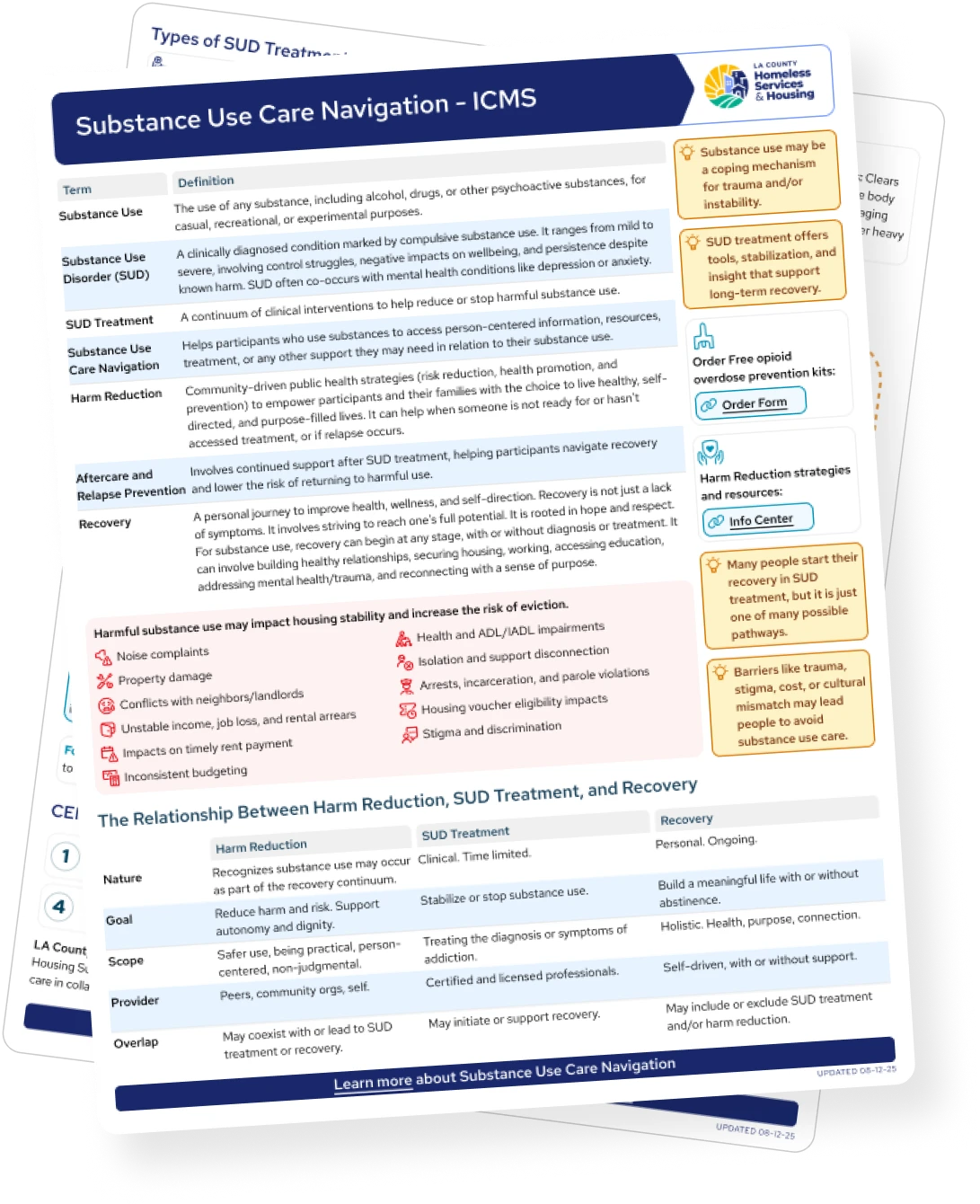
The use of any substance, including alcohol, drugs, or other psychoactive substances, for casual, recreational, or experimental purposes.
Substance Use Disorder (SUD)
A clinically diagnosed condition marked by compulsive substance use. It ranges from mild to severe, involving control struggles, negative impacts on wellbeing, and persistence despite known harm. SUD often co-occurs with mental health conditions such as depression or anxiety.
SUD Treatment
A continuum of clinical interventions to help reduce or stop harmful substance use. SUD treatment offers tools, stabilization, and insight that support long-term recovery.
Harm Reduction
Community-driven public health strategies including risk reduction, health promotion, and prevention to empower participants and their families with the choice to live healthy, self-directed, and purpose-filled lives. Harm reduction can help when someone is not ready for or has not accessed treatment, or if relapse occurs.
Aftercare and Relapse Prevention
Continued support after SUD treatment, helping participants navigate recovery and lower the risk of returning to harmful use.
Recovery
A personal journey to improve health, wellness, and self-direction. Recovery is not just the absence of symptoms. It can begin at any stage, with or without diagnosis or treatment. It may involve building healthy relationships, securing housing, accessing education, addressing mental health and trauma, and reconnecting with a sense of purpose.
Substance Use Care Navigation
Substance use care navigation helps participants who use substances access person-centered information, resources, treatment, or any other support they may need in relation to their substance use. Barriers like stigma, cost, or cultural mismatch may lead people to avoid SUD treatment — substance use care navigation helps bridge that gap.
- Substance use may be a coping mechanism for past trauma or instability
- Many people start their recovery in SUD treatment, but it is one of many pathways to recovery
Harm Reduction, SUD Treatment, and Recovery
These three approaches are distinct but complementary. Case managers should understand the differences to help participants access the right type of support at the right time.
SUD Treatment
Nature: Clinical. Time-limited.
Goal: Stabilize or stop substance use.
Scope: Focused on treating the diagnosis or symptoms of addiction.
Who Delivers: Certified and licensed professionals.
Relationship: May initiate or support recovery.
Recovery
Nature: Personal. Ongoing.
Goal: Build a meaningful life with or without abstinence.
Scope: Holistic — health, purpose, and connection.
Who Delivers: Self-driven, with or without support.
Relationship: May include or exclude SUD treatment and/or harm reduction.
Harm Reduction
Nature: Accepts substance use. Focuses on safer use, practical, person-centered, and non-judgmental.
Goal: Reduce harm and risk. Support autonomy and dignity.
Scope: Health, safety, rights, and social justice.
Who Delivers: Peers, community organizations, health workers, and self.
Relationship: May coexist with or lead to SUD treatment or recovery.
Housing Stability and Substance Use
Harmful substance use may impact housing stability and increase the risk of eviction. Case managers should monitor for these indicators:
- Noise complaints and property damage
- Conflicts with neighbors or landlords
- Unstable income, job loss, and rental arrears
- Impacts on timely rent payment and inconsistent budgeting
- Health and ADL/iADL impairments
- Isolation and support disconnection
- Arrests, incarceration, and parole violations
- Housing voucher eligibility impacts
- Stigma and discrimination
Harm Reduction Resources
CENS: Client Engagement Navigation Services
CENS provides tailored, hands-on, in-person navigation in the SUD system of care. Case managers can submit CENS referrals to connect participants to this specialized support.
Important: Confirm a participant’s universal sharing consent status before submitting a CENS referral.
Outreach, Engagement, and Education
Targeted outreach for referred ICMS participants. Presentations available on:
- SUD and treatment
- Cannabis risks
- Mental health and SUD connection
- Opioid overdose prevention
- Healthy coping
- Syringe exchange
- Harm reduction
- Relapse prevention
Personalized Substance Use Care Navigation
- Ongoing personal support navigating the SUD system of care
- Screens for SUD and the type and level of substance use care needed
- Schedules and arranges transportation for SUD treatment
Tracking Progress and Collaborating with ICMS
- Provides ICMS with ongoing updates on SUD treatment progress
- Collaborates with ICMS in linking participants to additional resources, health care, and social services
Key Resources
- Multilingual 24/7 Help Line: 1-800-854-7771 — unified entry point for mental health and substance use care in LA County
- RECOVER LA — publicly accessible mobile platform to explore and connect with SUD prevention, harm reduction, treatment, and recovery support in LA County. Includes the Service and Bed Availability Tool (SBAT).
CENS Referral Process
Use the steps below to submit and follow through on a CENS referral. Each time ICMS coordinates care in collaboration with a CENS navigator, record the ISP Care Coordination service in the Case Notes in CHAMP.
Note: For project-based ICMS, submit CENS referrals to the onsite CENS provider if applicable, or to the CENS Area Office where the participant is located. For scattered site ICMS, submit to the CENS Area Office for the SPA where the participant is located.
6-Step CENS Referral Flow

CENS Area Offices by Service Planning Area
CENS Area Offices are open Monday through Friday, 8:00 AM to 5:00 PM. Submit referrals to the office for the SPA where the participant is located.
SPA 1 — Tarzana Treatment Centers
44447 North 10th Street West, Lancaster, CA 93534
Phone: (661) 726-2630
SPA 2 — San Fernando Valley Community Mental Health Center
4515 Hamlin Street Suite 100, Van Nuys, CA 91411
Phone: (818) 285-1900
SPA 3 — Prototypes, A Program of Healthright 360
11227 Valley Boulevard, Suite 100, El Monte, CA 91731
Phone: (626) 444-0705
SPA 4 — Homeless Health Care Los Angeles
2330 Beverly Blvd, Los Angeles, CA 90057
Phone: (213) 744-0724
SPA 5 — Didi Hirsch Mental Health Services
4760 Sepulveda Boulevard, Culver City, CA 90230
Phone: (310) 895-2300
SPA 6 — Special Services for Groups — HOPICS
5715 S. Broadway Ave., Los Angeles, CA 90037
Phone: (323) 948-0444
SPA 7 — Los Angeles Centers for Alcohol and Drug Abuse
11015 Bloomfield Ave., Santa Fe Springs, CA 90670
Phone: (562) 273-0462 | Toll free: (844) 804-7727
SPA 8 — Behavioral Health Services
15519 Crenshaw Blvd., Gardena, CA 90249
Phone: (310) 973-2272
ISP Care Coordination
LA County’s Permanent Housing Integrated Services Program (ISP) includes the critical interventions of ICMS, Full Service Partnership (FSP), Housing Support Services Program (HSSP), and CENS to support housing retention and improved health and wellbeing.
Each time ICMS coordinates care in collaboration with a CENS navigator, the ISP Care Coordination service must be recorded in the Case Notes in CHAMP.