Mental Health Care Navigation
This resource supports ICMS case managers in identifying, assessing, and responding to the mental health needs of participants in Permanent Supportive Housing.
Use the tabs below to navigate key terminology, available interventions, DMH referral pathways, and crisis response protocols.

Understanding the Mental Health Continuum
Mental health is not a fixed state, it shifts over time in response to life circumstances, stress, and support. This continuum reflects the full range of experiences, from flourishing to crisis. Select a zone below to explore what each stage may look like.
Mental Health Terminology
Understanding these terms helps case managers recognize warning signs, communicate clearly with clinical partners, and advocate effectively for participants.
Note: These definitions are intended for case management practice. Always consult a clinical team member when assessing a participant’s mental health status.
Mental Health Decompensation
A deterioration in a person’s psychological functioning that reduces their ability to cope with everyday stressors or maintain previously stable functioning.
Decompensation does not mean permanent illness. Early identification and positive interventions can support recovery at any stage.
Mental Health Condition
A clinically significant disturbance in a person’s thoughts, emotions, or behavior. Mental health conditions vary widely in type and severity and are addressed through a range of treatment and support options.
Serious Mental Illness (SMI)
A diagnosed mental, behavioral, or emotional disorder that causes severe disruption to daily functioning, including work, school, relationships, and self-care. SMI typically requires more intensive levels of treatment and case management support.
Recovery
A personal journey toward improved health, wellness, and self-direction. Recovery is rooted in hope and respect. It is not defined by the absence of symptoms alone and can begin at any time, with or without a diagnosis or active treatment.
Recovery may include building healthy relationships, securing stable housing, accessing education or employment, receiving substance use care, and reconnecting with a sense of purpose.
Interventions That Support Mental Health
Case managers can connect participants to a range of evidence-informed supports. These interventions address mental health needs across clinical, social, and daily functioning domains.
Psychotherapy
Talk therapy to help participants process emotions, build coping skills, and improve mental health functioning over time.
Medical Care and Prescriptions
Psychiatric evaluation, medication management, and clinical guidance to reduce symptoms and support day-to-day stability.
Peer Support
Guidance and encouragement from individuals with lived mental health experience who can model recovery and build trust with participants.
Care Team Coordination
Collaborative care planning through provider communication and case conferencing. Ensures all supports are aligned and responsive to participant needs.
Mental Health Care Navigation
Case manager assistance with scheduling appointments, supporting medication adherence, and advocating for participants to maintain engagement with care.
Inpatient Mental Health Care
Structured, short-term hospital stays for safe stabilization and intensive treatment when outpatient supports are not sufficient.
Caregiving
Ongoing daily support with activities of daily living (ADLs) and instrumental activities of daily living (IADLs). Ensures participant safety, stability, and continuity of care.
Emotional Support Animals
Companion animals that provide comfort, reduce stress, and support emotional wellbeing as part of a participant’s overall care plan.
Capacity Building and Training
HSH offers trainings and process groups to help case managers build skills in mental health assessment, communication, and care navigation.
- Access HSH Capacity Building Trainings (link coming soon)
- Access HSH Process Groups (link coming soon)
Connecting Participants to Behavioral Health Services
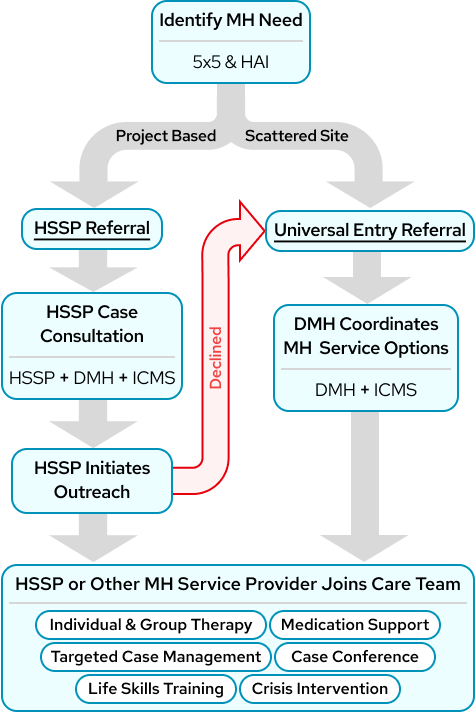
ICMS case managers can refer participants to LA County’s behavioral health care continuum through two primary pathways. Use these tools to connect participants to the level of care that matches their current needs.
Important: Confirm a participant’s universal sharing consent status before submitting any mental health care referral.
Housing Supportive Services Program (HSSP)
HSSP provides site-based mental health services within Permanent Supportive Housing buildings. If your PSH building has HSSP onsite, contact HSSP directly.
DMH Universal Entry Referral
A unified entry point and triage pathway for all levels of mental health services in LA County. Use this form when HSSP is not available onsite or when a participant needs a higher level of care.
About PH² Outreach
PH² is an advanced outreach option for participants who are at risk of eviction, are not currently engaged in mental health services, and reside in PSH buildings without onsite HSSP.
When to use PH²
- Participant is at risk of eviction
- Participant is not currently engaged in mental health services
- Participant resides in a PSH building without onsite HSSP
If your PSH building has HSSP onsite, contact HSSP directly rather than initiating a PH² referral.
Not sure which pathway to use?
Start with HSSP if available onsite. If not, use DMH Universal Entry. Contact your supervisor if a participant needs a higher level of care than either pathway can address.
Responding to a Mental Health Crisis
When a participant experiences a mental health crisis, a timely and structured response can protect their safety and support recovery. Use the steps below based on the level of urgency. Always notify your supervisor and relevant staff after taking action.
Urgent Situation
Use when a participant shows signs of mental health distress that require prompt attention but do not pose an immediate safety risk.
- Check for on-site mental health support first.
- Offer a referral to Psychiatric Urgent Care.
- Dial 988 for the Suicide and Crisis Lifeline.
- Call the 24/7 Help Line: 1-800-854-7771.
- Notify your supervisor and relevant staff.
Emergency Situation
Use when there is an immediate safety risk to the participant or others that requires emergency response.
- Take action to address the immediate safety risk.
- Dial 911. Provide your callback number, location, and a description of the situation and any individuals involved.
- Notify your supervisor and relevant staff.
Crisis and Help Line Resources
These resources are available 24 hours a day, 7 days a week and support participants across language needs.
- 988 Suicide and Crisis Lifeline: Dial or text 988
- LA County 24/7 Help Line: 1-800-854-7771 — Multilingual unified entry point for mental health and substance use care in LA County
- Emergency: Dial 911 for immediate safety emergencies only
Note: The multilingual 24/7 Help Line (1-800-854-7771) is a unified entry point for both mental health and substance use care in LA County.
24-Hour Psychiatric Urgent Care Centers
These centers provide around-the-clock psychiatric urgent care for individuals experiencing a mental health crisis. Case managers can refer participants to any of the following locations based on geography and availability.
Exodus Recovery — South LA
12021 S. Wilmington Ave., 2nd Floor
Los Angeles, CA 90059
- Phone: (562) 295-4617
- Hours: 24 hours, 7 days a week
Exodus Recovery — Eastside
1920 Marengo St.
Los Angeles, CA 90033
- Phone: (323) 276-6400
- Hours: 24 hours, 7 days a week
High Desert Behavioral Health
415 E Avenue I
Lancaster, CA 93535
- Phone: (661) 522-6770
- Hours: 24 hours, 7 days a week
BHUCC — City of Industry
18501 Gale Ave., Suite 100
City of Industry, CA 91748
- Phone: (626) 626-4997
- Hours: 24 hours, 7 days a week
BHUCC — Long Beach
3210 Long Beach Blvd.
Long Beach, CA 90807
- Phone: (562) 548-6565
- Hours: 24 hours, 7 days a week