
Incident Report Form
Form for reporting critical incidents involving ICMS participants or program operations. Complete ALL sections of this form.
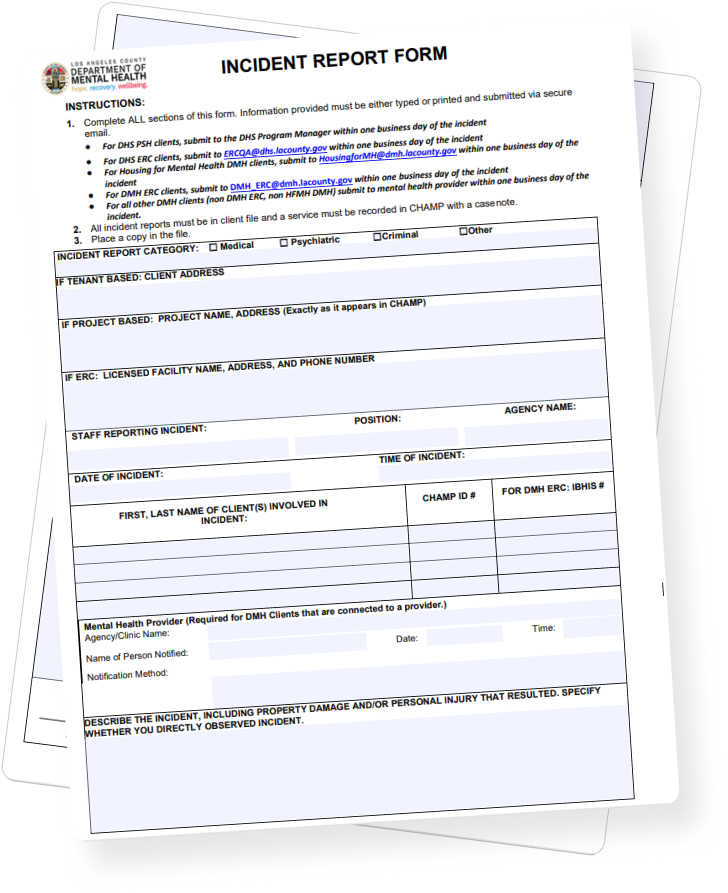
Criteria For Reporting Incidents (Not All-Inclusive)
- Criminal behavior that results in law enforcement involvement. This could include incidents that do not result in an arrest or prosecution.
- Suicidal ideation requiring PET, law enforcement, or EMT.
- Domestic violence/intimate partner violence. This could include incidents that are not reported to law enforcement.
- Property damage that is of major concern to the ICMS provider, client, and others on the property (e.g., fire, major unit damage, water damage, or other environmental concerns that could affect the health or tenancy of the client).
- Assaultive behavior towards staff, fellow clients, client guests, housing providers, facility vendors, or neighbors that occurs in the client’s unit or building, as well as any property damage that occurs on the contractor’s facility. This could include incidents that do not result in arrest or prosecution.
- Death.
- Any cases where incidents are reported as the result of mandatory reporter responsibility of staff. This includes reports to DCFS or APS.
- Recognition and/or confiscation of dangerous or unauthorized items (e.g., weapons, paraphernalia).
- Fire, major unit damage, water damage, or other environmental concerns that could affect the health or tenancy of the participant.
- Verbal or physical threats or altercations (e.g., assaultive behavior towards staff, roommates, housing providers, neighbors, or fellow clients).
- Medical episode that is of major concern (e.g., seizure, adverse drug reaction), requiring EMT.
- Homicide (suspected or alleged homicide by client).
- Psychiatric mental health episode that is of major concern (e.g., psych hold), requiring EMT, law enforcement, or PMRT.
- A critical event that has or may generate governmental and/or immediate community-wide attention and may require notification by the contractor (DHS, DMH, ODR, etc.) to the board of supervisors.
- Suspected or alleged interpersonal relationship with a client by staff. Please report to your supervisor.
To access this information including a PowerPoint use this link. This PowerPoint includes an annotated example of a completed SIR Form.
Submitting a Completed SIR Form
- Once completed, as noted in the instructions at the top of the form, the SIR must be submitted via secure email.
- Submit completed form to appropriate contact and provider within one (1) business day of incident.
- For DHS PSH clients, submit to DHS program manager
- For DHS ERC clients, submit to ERCQA@dhs.lacounty.gov
- For DMH clients, submit to housing for MH@dmh.lacounty.gov
- For DMH ERC clients, submit to DMH_ERC@dmh.lacounty.gov
- Copy all appropriate providers when submitting completed form i.e., for an FHSP project-based client, send to the program manager and the BC housing coordinator
- In addition to submitting completed SIR form:
- A service must be recorded in CHAMP with a case note
- A copy of the SIR must be placed in the client file
Mandated Reporting Simplified
DOMESTIC VIOLENCE
- Penal Code: 11160-11163.5
- Who Must Report: Health providers employed in a health facility
- What Gets Reported: Any wound inflicted by a firearm or suspected to be the result of assaultive or abusive conduct
- To Whom Is Report Sent: Local law enforcement
- What Is Time Frame for Reporting:
-
- Report by telephone immediately
- Written report within two working days
CHILD ABUSE & NEGLECT
- Penal Code: 11165-11174.3
- Who Must Report: Childcare custodians, health practitioners, child protective agency personnel, child visitation monitors, firefighters, animal control officers or humane society officers, commercial film and photographic processors and clergy
- What Gets Reported: Suspected child abuse or neglect
- To Whom Is Report Sent: County welfare (child protective services agency), probation, or police or sheriff’s department
- What Is Time Frame for Reporting:
-
- Report by telephone immediately
- Written report within 36 hours
CHILD ABUSE UNLAWFUL SEXUAL INTERCOURSE
- Penal Code: 261.5(definition) / Penal Code: 11165-11174.3
- Who Must Report: Child care custodians, health practitioners, child protective agency personnel, child visitation monitors, firefighters, animal control officers or humane society officers, commercial film and photographic processors and clergy
- What Gets Reported:
- Sexual conduct of a person under 14 with older person
- Sexual conduct of person under 16 with person 21+
- Sexual conduct of 16 or 17 years old when possibility of abuse exists
- To Whom Is Report Sent: County welfare (child protective services agency), probation or police or sheriff’s department
- What Is Time Frame for Reporting:
-
- Report by telephone immediately
- Written report within 36 hours
DEPENDENT ADULT ELDER ABUSE
- Welfare and Institutions Code: 15630-15632
- Who Must Report: Any person who has care of custody of an elder or dependent adult, including administrators, supervisors and any licensed staff of a public or private facility, or any elder or dependent adult care custodian, health practitioner, or employee of a county adult protective services agency or a local law enforcement agency
- What Gets Reported: Suspected physical, psychological and financial abuse or neglect
- To Whom Is Report Sent: County welfare (adult protective services agency) / Local law enforcement
- What Is Time Frame for Reporting:
-
- Report by telephone immediately
- Written report within two working days
What are mandated reporters required to report?
Mandated reporters are required to report “suspected” child abuse or neglect. The mandated reporter can have personal knowledge of the child abuse or neglect, such as a child telling them or seeing it themselves, or “reasonably suspect” that a child is experiencing abuse or neglect. No actual proof of abuse or neglect is needed.
California law defines child abuse as when someone purposefully physically injures a child, subjects a child to cruelty or unjustifiable punishment, and/or sexually abuses or exploits a child.
California law defines neglect as when a parent or caretaker fails to provide a child with adequate food, clothing, shelter, medical care, or supervision.
Identifying Risks During Home Visits
There are types of significant incidents that become “Urgent Cases”. Due to various circumstances such as a Supervisor has gotten involved, or there has been a death or some kind of event that could be of interest to the news media. The Significant Incident will be bumped up. This kind of case requires immediate attention due to its escalation to a Board level and the involvement of key offices including the homeless deputy’s office, Homeless Initiative office, and County CEO office. Time sensitivity underscores the critical nature of our response, with expectations for resolution typically within a day or two. Therefore, it’s imperative to approach these cases with a sense of urgency.
Important: While final resolutions may not always be attainable, the focus should be on incremental progress and ongoing support towards the best possible outcome for the client.
IMPORTANT THINGS TO GATHER:
It is important that your Significant Incident Report contain the following information so that the people at DHS who will be handling this really know what occurred:
- Timeline of ICMS work with the client. What happened that caused this case to be elevated?
- Plan of Action from ICMS
- What is the plan moving forward?
- The 5Ws (Who? What? Where? When? Why? How?)
YOUR PROGRAM MANAGER (or someone higher) will likely be taking care of this after you have prepared the Significant Incident Report Form.