
Permanent Housing Retention Assistance
Permanent Housing Retention Assistance is a participant-centered service to help ICMS case managers support individuals and families in staying housed for the long term.
It combines collaborative care planning, proactive safety and stability support, eviction prevention, and wellness promotion — with a focus on incremental progress and participant empowerment.
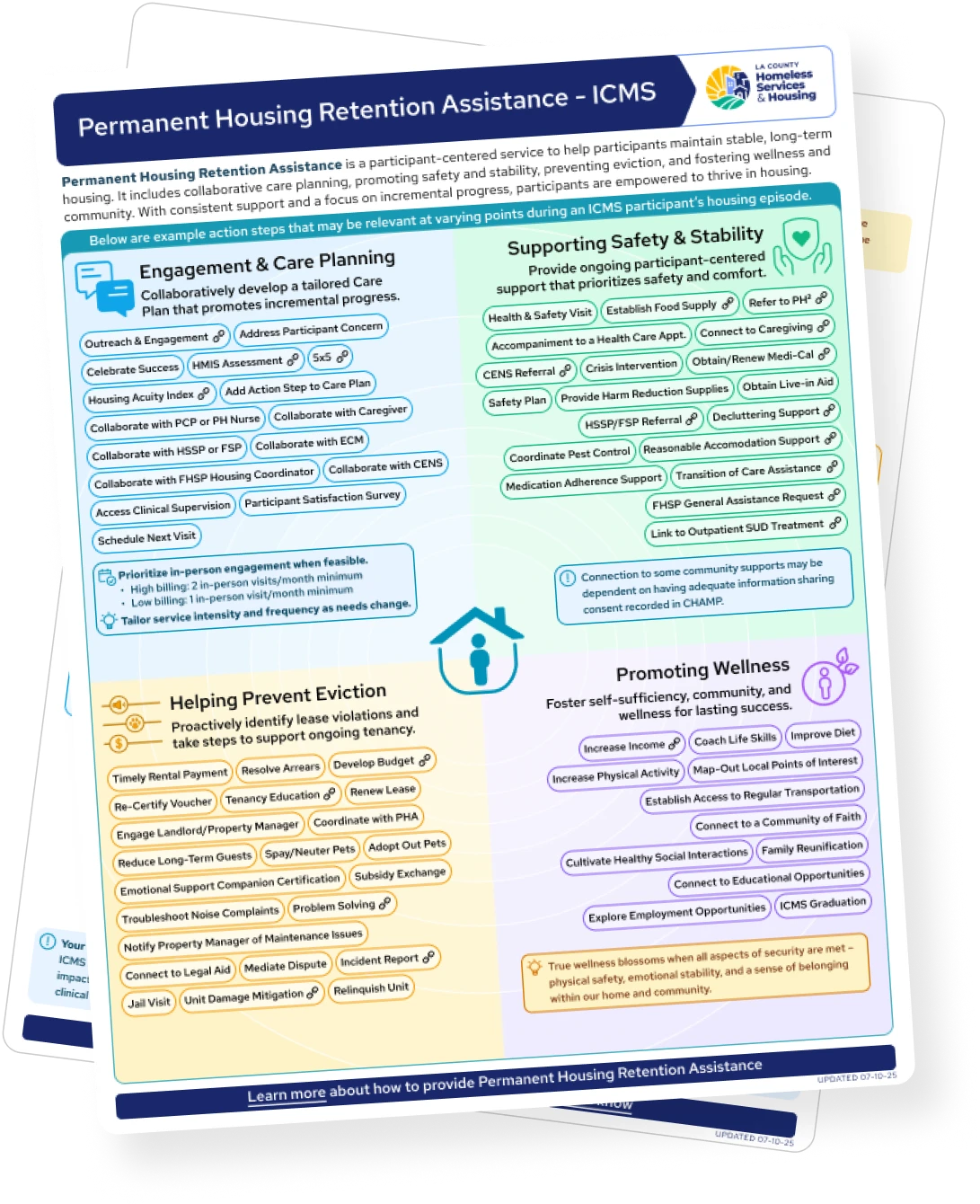
Four Pillars of Housing Retention
Effective housing retention is built on four core strategies. Case managers use these pillars to guide care planning, identify risks, and provide the right support at the right time. Tailor service intensity and frequency as participant needs change.
Engagement and Care Planning
Collaboratively develop a tailored Care Plan that promotes incremental progress. Prioritize in-person engagement when feasible.
- Outreach and engagement
- Address participant concerns
- Celebrate successes
- HMIS Assessment
- 5×5 and Housing Acuity Index
- Add action steps to Care Plan
- Collaborate with PCP, Caregiver, HSSP or FSP, ECM, and FHSP Housing Coordinator
- Collaborate with CENS
- Access clinical supervision
- Participant Satisfaction Survey
- Schedule next visit
High billing: 2 in-person visits per month. Low billing: 1 in-person visit per month.
Supporting Safety and Stability
Provide ongoing participant-centered support that prioritizes safety and comfort. Connection to some community supports may depend on adequate information sharing consent in CHAMP.
- Health and Safety Visit
- Establish food supply
- Obtain or renew Medi-Cal
- Accompaniment to health care appointments
- Connect to caregiving
- Refer to PH2
- Submit HSSP or FSP referral
- Provide harm reduction supplies
- Decluttering support
- Medication adherence support
- Coordinate pest control
- Safety Plan
- Reasonable accommodation support
- FHSP General Assistance Request
- Obtain live-in aid
- Submit CENS referral
- Transition of care assistance
- Outpatient SUD treatment
- Crisis intervention
Helping Prevent Eviction
Proactively identify lease violations and take steps to support ongoing tenancy.
- Timely rental payment
- Resolve arrears
- Develop budget
- Re-certify voucher
- Tenancy education
- Renew lease
- Engage landlord or property manager
- Coordinate with PHA
- Reduce long-term guests
- Spay or neuter pets
- Adopt out pets
- Emotional Support Companion Certification
- Subsidy exchange
- Troubleshoot noise complaints
- Notify property manager of maintenance issues
- Connect to legal aid
- Mediate dispute
- Problem solving
- Incident report
- Jail visit
- Unit damage mitigation
- Relinquish unit
Promoting Wellness
Foster self-sufficiency, community, and wellness for lasting success. True wellness blossoms when all aspects of security are met — physical safety, emotional stability, and a sense of belonging within home and community.
- Increase income
- Coach life skills
- Improve diet
- Increase physical activity
- Map out local points of interest
- Establish access to regular transportation
- Connect to a community of faith
- Cultivate healthy social interactions
- Family reunification
- Connect to educational opportunities
- Explore employment opportunities
- ICMS graduation
Routine Health and Safety Visit
The routine health and safety visit is an opportunity to establish consistency and build trust. Through caring and purposeful conversations, case managers can foster deeper engagement, helping participants feel empowered to actively collaborate in shaping their wellness and future for lasting stability.
Use the ICMS Snapshot to track outreach, assessments, care planning, care team collaboration, and service provision. 5×5 and HAI scores help inform the purpose of home visits and the direction of the Care Plan.
Step 1: Prepare for Home Visit
Remind the participant and review the ICMS Snapshot, Care Plan, and previous notes before arriving.
Step 2: Arrive and Engage
Arrive at the participant’s home at the scheduled time and initiate contact. Celebrate recent successes and ask about any new concerns or needs.
Step 3: Assess for Risks
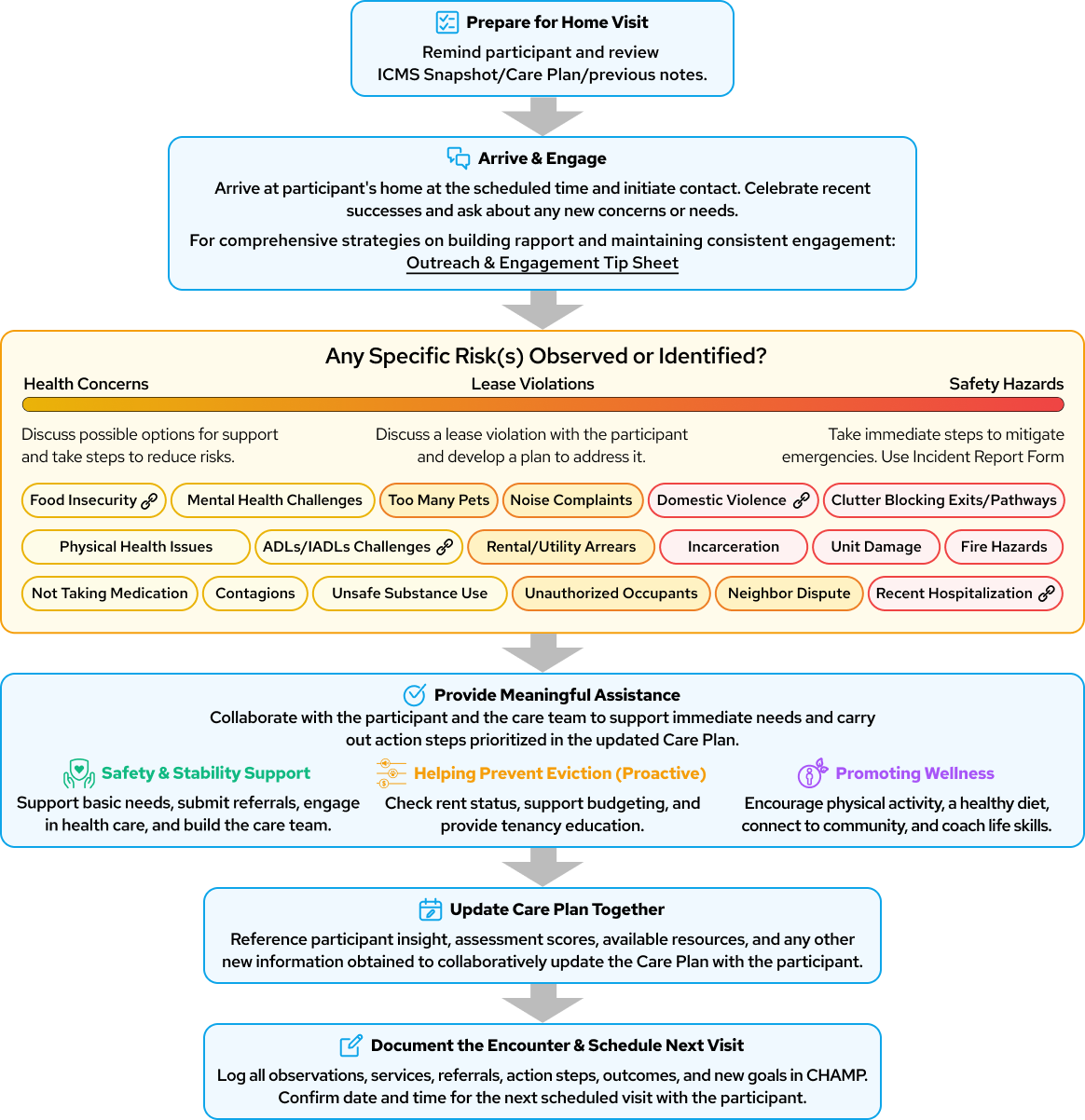
Identify any specific risks observed or reported. Respond based on the type of concern:
- Health Concerns: Discuss support options and steps to reduce risks
- Lease Violations: Discuss the violation and develop a plan to address it
- Safety Hazards: Take immediate steps to mitigate emergencies — use Incident Report Form
Step 4: Provide Meaningful Assistance
Collaborate with the participant and the care team to support immediate needs and carry out action steps prioritized in the updated Care Plan. Draw on all four pillars as appropriate.
Step 5: Update Care Plan Together
Reference participant insight, assessment scores, available resources, and any new information to collaboratively update the Care Plan with the participant.
Step 6: Document and Schedule Next Visit
Log all observations, services, referrals, action steps, outcomes, and new goals in CHAMP. Confirm the date and time of the next scheduled visit with the participant.
Visit Flow Diagram
The diagram below illustrates the full health and safety visit workflow. Replace the placeholder image with the visit flowchart graphic.
Identifying Risks During Home Visits
During each home visit, case managers should assess whether any specific risks are present and respond appropriately. The following risk categories cover the most common concerns identified during routine visits.
Important: Take immediate steps to mitigate emergencies and use the Incident Report Form for any safety hazards identified during a visit.
Health Concerns
- Food insecurity
- Mental health challenges
- Physical health issues
- ADL and iADL challenges
- Not taking medication
- Contagions
- Unsafe substance use
- Recent hospitalization
Lease Violations
- Too many pets
- Noise complaints
- Rental or utility arrears
- Incarceration
- Unauthorized occupants
- Neighbor dispute
Safety Hazards
- Domestic violence
- Clutter blocking exits or pathways
- Unit damage
- Fire hazards
Guidance for Case Managers
Housing retention is challenging, sustained work. These principles help case managers approach their role with clarity, balance, and a focus on what matters most for participants.
Empowerment Over Enforcement
The case manager’s role is to support participants in successfully maintaining their own household — not to dictate terms or act as an enforcer. Approach each visit as a partner in the participant’s journey toward stability.
Your Wellbeing Matters Too
ICMS is challenging work. To prevent burnout and ensure long-term impact, focus on building out the care team to share the load, access clinical supervision regularly, and prioritize self-care.
Additional Resources
coming soon